Situation Summary
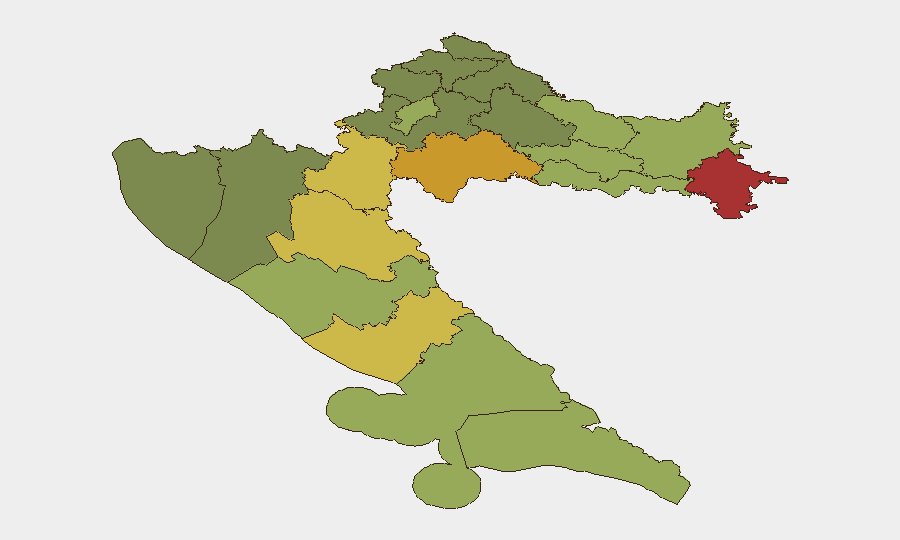
Croatia remains a low-threat environment globally (rank #161, composite score 7), with no discrete security incidents recorded in the current tracking window. The country's risk profile is regionally skewed: the eastern borderlands—Vukovar-Srijem, Sisak-Moslavina, and Karlovac counties—carry elevated composite scores reflecting legacy post-conflict fragility, unexploded ordnance (UXO), and socioeconomic strain, while central and coastal zones score substantially lower. Near-term trajectory is stable, with infrastructure and labor disputes posing operational friction rather than safety threats to corporate personnel.
Key Developments
- Zagreb, September 28–29: ZET and Zagreb Holding transport workers initiated a strike, reducing tram and bus services to minimal levels (lines 11, 17, and limited bus routes). A County Court hearing on September 29 addressed management motions to prohibit the action. Impact: significant commute disruption in the capital.
- Brač Island (Gornji Humac–Selca), September 21–23: Croatian police bomb-disposal and mountain rescue teams extracted approximately 15 World War II explosive devices, including a ~50 kg German aerial bomb, from Gustrišica cave. No casualties; routine UXO remediation in a known contamination zone.
- Zagreb, September 26: The opposition SDP party filed a no-confidence motion against Prime Minister Andrej Plenković, citing an alleged illegal-waste dumping scandal. Political pressure is escalating but remains within parliamentary process.
- Split Airport, September 24: Border authorities detained two Afghan nationals carrying identity documents bearing the names of historic Croatian rulers (Knez Trpimir, Kralj Ladislav). Source reporting suggests document fraud investigation; details remain limited.
- Rijeka Region, September 24: A magnitude 1.9 earthquake occurred approximately 30 km southeast of Rijeka at 09:00 local time (EMSC data). Minor, no reported damage.
- Rijeka Region, September 25: A second magnitude 1.9 earthquake recorded approximately 27 km east of Rijeka at 06:23 local time (EMSC data). Minor seismic activity; no impact reported.
Highest-Risk Areas
Vukovar-Srijem, Sisak-Moslavina, and Karlovac counties dominate the sub-national risk ranking (scores 78, 72, 68 respectively), reflecting their status as post-1990s conflict zones with persistent UXO contamination, lower economic recovery, and demographic challenges. These eastern and south-central regions warrant heightened awareness for mine/ordnance risks and slower institutional capacity. Zagreb and the Dalmatian coast (Split-Dalmatia, Zadar, Šibenik-Knin) carry moderate composite scores driven primarily by urbanization, seasonal tourism volatility, and petty crime rather than acute instability. Risk stratification is clear: east > center > coast, though absolute threat levels remain low countrywide.
How GeoBit Would Assist
Security teams operating in Croatia should deploy AOI Monitoring & Early Warning on eastern counties (Vukovar-Srijem, Sisak-Moslavina) for UXO/accident alerts and civil unrest signals. Intel Sweep and multi-language OSINT provide real-time tracking of labor disputes, political developments, and infrastructure disruptions that affect duty-of-care logistics. Routing & Network Analysis enables dynamic travel planning around transport strikes and conflict-legacy zones, while Satellite & Imagery analysis supports facility vulnerability assessment in high-risk sub-regions.
7-Day Outlook
The Zagreb transport strike will likely resolve or escalate within 3–5 days pending court decision and negotiation outcome. Political friction over the waste scandal will persist at parliamentary level but poses no acute operational risk. Minor seismic activity near Rijeka is typical for the region and does not warrant operational constraint. Overall risk posture remains stable; monitor labor actions and court decisions as primary near-term variables.
Highest-Risk Areas — Ranked
| # | State / Region | Risk |
|---|---|---|
| 1 | Vukovar-Srijem County | 78 |
| 2 | Sisak-Moslavina County | 72 |
| 3 | Karlovac County | 68 |
| 4 | Lika-Senj County | 65 |
| 5 | Šibenik-Knin County | 62 |
| 6 | Brod-Posavina County | 58 |
| 7 | Zadar County | 55 |
| 8 | Osijek-Baranja County | 52 |
| 9 | City of Zagreb | 50 |
| 10 | Split-Dalmatia County | 48 |
| 11 | Požega-Slavonia County | 45 |
| 12 | Virovitica-Podravina County | 42 |
Sources
Previous Weekly Briefs
A new Croatia brief is written every Monday, covering the week — each with its own risk map and downloadable CSV. Use the calendar to go further back.
- September 22, 2026
- September 15, 2026
- September 9, 2026
- September 3, 2026
- August 31, 2026
- August 28, 2026
- August 26, 2026
📅 Browse past briefs by calendar →
Highlighted days have a brief. Tap a day for that day's map & analysis, or “csv” for that day's dataset ($5).
Atlas — our AI intelligence desk — emails them this snapshot personally. Nothing else, no list.