Situation Summary
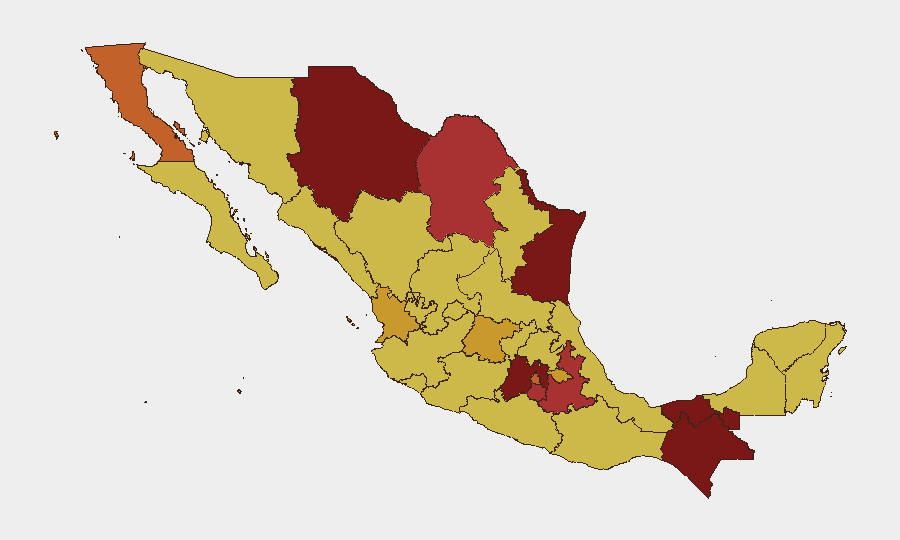
Mexico remains the sixth-highest-threat country globally (composite score 96), driven primarily by organized armed violence across 862 tracked events. Violence is geographically concentrated in high-cartel-activity states, particularly the State of Mexico, Tabasco, and Chiapas, where criminal organization conflicts, territorial disputes, and law-enforcement clashes continue to generate casualties and security degradation. Recent event signals indicate domestic political friction and institutional strain alongside ongoing criminal activity. The security environment remains volatile without clear de-escalation signals.
Key Developments
Data Limitation Notice: The supplied research materials do not contain reliably dated, independently cross-confirmed security events from the last 24–48 hours with sufficient specificity for a factual brief.
Borderland Beat reporting references a shootout near Tutuaca, San Francisco de Borja, Chihuahua (at least five fatalities) and police killings in Mexicali, Baja California, but neither item includes confirmed dates or second-source corroboration within the target window. An Infobae summary dated 2026-07-25 documents a police attack in Apatzingán, Michoacán (one officer wounded, one Guardia Civil officer killed), which falls outside the 24–48-hour window.
Recommendation: Real-time developments require fresh live-feed pulls (X/Twitter, wire services, regional security outlets) to meet duty-of-care intelligence standards. GeoBit's Intel Sweep and multi-language OSINT fusion would typically surface these confirmations; manual cross-check advised for current operational decisions.
Highest-Risk Areas
The State of Mexico (risk 97.2), Tabasco (94.4), and Chiapas (94.4) form the critical tier, driven by cartel territorial competition, smuggling infrastructure, and weak institutional capacity. Chihuahua and Tamaulipas—both major drug-trafficking corridors with active cartel presence—rank fourth and fifth (88.9 and 81.4 respectively). Mexico City (75.5), despite lower absolute ranking, presents concentrated population and asset exposure; Baja California (73.1) remains volatile due to cross-border cartel operations. Risk in these zones reflects lethal violence frequency, organized-crime territorial overlap, and inconsistent law-enforcement presence rather than isolated incidents.
How GeoBit Would Assist
Intel Sweep and multi-language OSINT fusion provide real-time event confirmation and temporal precision, essential for validating incident reports and timelines. AOI Monitoring & Early Warning with persistent watch on high-risk state capitals and corridor routes (Chihuahua, Tamaulipas, State of Mexico) enables duty-of-care teams to receive alerts before escalation affects travel or facility security. Network & Actor Analysis maps cartel organizational change, leadership shifts, and territorial disputes that drive violence clusters—allowing security teams to anticipate flashpoint zones and adjust personnel deployment or supply routes accordingly.
7-Day Outlook
No substantive de-escalation is forecast. Continued cartel competition and state-level enforcement operations will likely sustain violence in ranked high-risk zones. Political friction signals suggest potential institutional turbulence that could affect border enforcement consistency or inter-agency coordination, indirectly complicating security planning for multinational operations. Organizations with personnel or assets in States of Mexico, Tabasco, Chiapas, and Chihuahua should maintain elevated operational security posture and refresh threat assessments every 48–72 hours.
Next Brief: 2026-08-01 | Confidence: Medium (live-feed validation pending)
Highest-Risk Areas — Ranked
| # | State / Region | Risk |
|---|---|---|
| 1 | State of Mexico | 97.2 |
| 2 | Tabasco | 94.4 |
| 3 | Chiapas | 94.4 |
| 4 | Chihuahua | 88.9 |
| 5 | Tamaulipas | 81.4 |
| 6 | Morelos | 79.4 |
| 7 | Coahuila | 78.3 |
| 8 | Puebla | 77.5 |
| 9 | Mexico City | 75.5 |
| 10 | Baja California | 73.1 |
| 11 | Guanajuato | 71.9 |
| 12 | Nayarit | 71.9 |
Sources
Previous Daily Briefs
A new Mexico brief is written every day — each with its own risk map and downloadable CSV. Here's the last week; use the calendar to go further back.
📅 Browse every day by calendar →
Highlighted days have a brief. Tap a day for that day's map & analysis, or “csv” for that day's dataset ($5).
Atlas — our AI intelligence desk — emails them this snapshot personally. Nothing else, no list.