Situation Summary
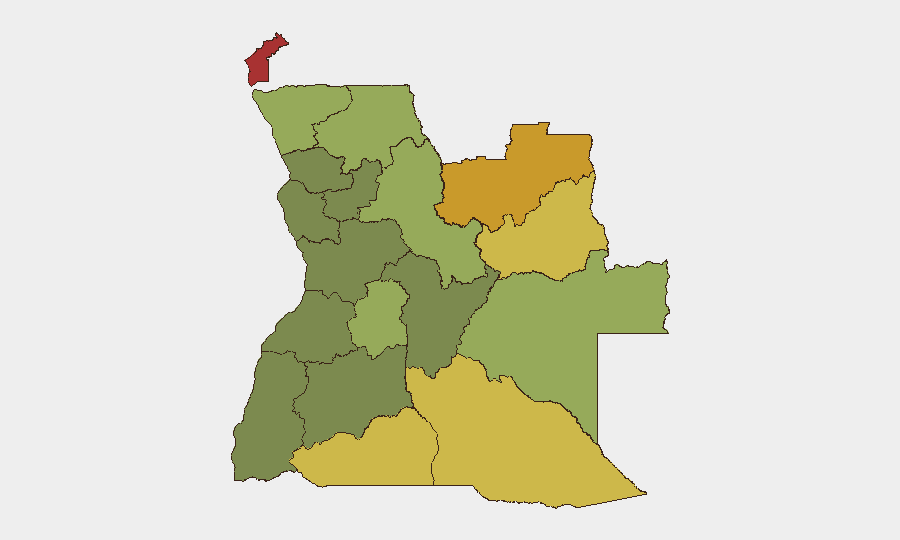
Angola remains a lower-tier global security concern (rank #57, composite threat score 32) with no verified major incidents in the last 24–48 hours. However, significant sub-national variation exists: the diamond-mining provinces of Cabinda, Lunda Norte, and Lunda Sul (risk scores 78, 72, 68 respectively) carry substantially elevated risk from armed group activity, trafficking, and localized conflict. The most recent corroborated event—a police intervention against a UNITA political gathering in Uíge Province on 8–9 August resulting in 31 injuries—reflects underlying political tension, though the country remains broadly stable outside high-risk eastern and northern zones.
Key Developments
No verified security, civil-unrest, crime, or infrastructure incidents have been corroborated for Angola in the 24–48 hours preceding 2026-08-19. Live web research and available event feeds contain no reportable incidents specific to 18–19 August. The most recent concrete event on record—police dispersal of a UNITA assembly in Uíge Province on 8–9 August using tear gas and gunfire, with 31 reported injuries—remains the active indicator of political assembly risk but falls outside the current 24–48-hour window.
Highest-Risk Areas
Cabinda Province (risk 78) dominates Angola's threat landscape, driven by historical separatist activity and armed-group presence associated with the FLEC movement and criminal networks exploiting oil-sector infrastructure and porous borders. Lunda Norte and Lunda Sul (72 and 68 respectively) face acute risk from artisanal and illicit diamond mining, trafficking corridors to the Democratic Republic of Congo, and limited state capacity in remote areas. Cuando Cubango and Cunene provinces (64 and 62) experience cross-border smuggling and sporadic intercommunal tension. By contrast, the central and southern provinces (Bié, Huíla, Malanje) register notably lower composite scores, reflecting stronger state presence and lower conflict activity.
How GeoBit Would Assist
Corporate security teams with personnel or assets in Angola's diamond provinces should employ AOI Monitoring & Early Warning to track Cabinda, Lunda Norte, and Lunda Sul for emerging armed-group movements, trafficking indicators, and infrastructure incidents. Network & Actor Analysis combined with OSINT fusion (X/Twitter, Telegram, local media, and radio SIGINT) would provide early warning of political assembly disruptions or cross-border incursions before they affect operations. Routing & Network Analysis supports duty-of-care planning by identifying safe transit corridors and alternative supply routes around high-risk diamond zones.
7-Day Outlook
No imminent escalation is forecast for Angola over the next seven days. However, political tensions around UNITA activities and broader opposition movements remain a persistent low-to-moderate risk, particularly in northern provinces such as Uíge and Zaire. Routine trafficking, artisanal mining disputes, and cross-border security incidents in the eastern provinces should be expected to continue at baseline levels; corporate teams should maintain standard monitoring and travel-restriction protocols for Cabinda and the Lundas.
Highest-Risk Areas — Ranked
| # | State / Region | Risk |
|---|---|---|
| 1 | Cabinda Province | 78 |
| 2 | Lunda Norte Province | 72 |
| 3 | Lunda Sul Province | 68 |
| 4 | Cuando Cubango Province | 64 |
| 5 | Cunene Province | 62 |
| 6 | Moxico Province | 58 |
| 7 | Zaire Province | 54 |
| 8 | Huambo Province | 50 |
| 9 | Uíge Province | 48 |
| 10 | Malanje Province | 42 |
| 11 | Bié Province | 35 |
| 12 | Huíla Province | 32 |
Sources
Previous Daily Briefs
A new Angola brief is written every day — each with its own risk map and downloadable CSV. Here's the last week; use the calendar to go further back.
- August 17, 2026
- August 15, 2026
- August 13, 2026
- August 11, 2026
- August 9, 2026
- August 8, 2026
- August 7, 2026
📅 Browse every day by calendar →
Highlighted days have a brief. Tap a day for that day's map & analysis, or “csv” for that day's dataset ($5).
Atlas — our AI intelligence desk — emails them this snapshot personally. Nothing else, no list.