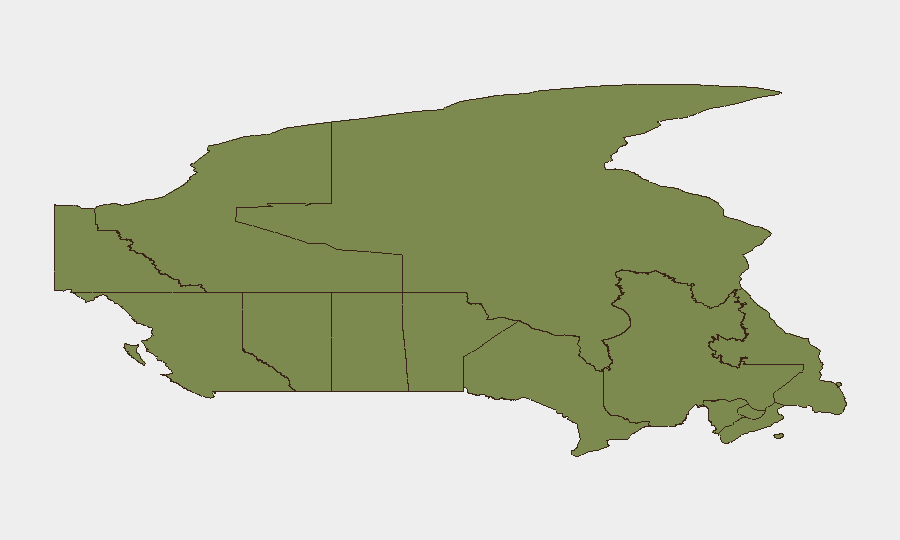
Situation Summary
Canada's composite threat score of 7 places it at rank #96 globally, with 1,756 tracked events in the monitoring window. The most recent 24-hour signal cluster (27 July) shows elevated diplomatic and investigative activity centered on federal and provincial statements, military messaging, and police-level investigations. Ontario and British Columbia continue to dominate sub-national risk, driven by compound factors including cross-border tensions, resident movements, and ongoing investigative actions. The trajectory suggests sustained diplomatic friction and domestic security operations rather than acute destabilization.
Key Developments
- Federal rejection of Iran-related matter (27 July, Canada-wide): A diplomatic rebuff was publicly signaled, elevating international-relations risk posture. Implications for travel, trade, and cross-border scrutiny remain active.
- Victoria-level statement (27 July, British Columbia): Provincial-level communication released on an unspecified matter. BC's elevated risk score (28) suggests this may relate to resident or border-adjacent concerns.
- Military public statement (27 July, Canada-wide): Defense messaging entered the public record. Context unclear; monitor for ongoing operational communications.
- Police investigation announced (27 July, Ontario): Law enforcement action initiated; public statement issued. Ontario's critical risk score (31.4) reflects concentration of such investigative activity.
- Resident expulsion/deportation activity (26 July, multi-province): Movement of persons flagged across two provinces (New Brunswick referenced explicitly). May indicate immigration enforcement or security-related removals; monitor for scale and cascade effects.
- Advocacy rejection re: Toronto (27 July, Ontario): A civil or political advocacy claim was formally rejected by an entity, signaling internal contestation or enforcement of policy boundaries.
- Israeli disapproval statement regarding Canada (27 July, international dimension): Diplomatic criticism from a foreign actor; may affect trade, sanctions compliance, or community relations in Canada.
- Threat signal (27 July, source unspecified): A threat was articulated and entered the event record; specificity and target classification require deeper intelligence fusion.
Highest-Risk Areas
Ontario (31.4) and British Columbia (28.0) account for the majority of tracked risk events and signal intensity. Ontario's dominance reflects concentrated police/investigative activity, federal-provincial friction, and resident-movement events. BC's elevation correlates with cross-border exposure, diplomatic statements, and resident-security matters. Quebec (13.1) and the three northern territories (Yukon 12.3, NWT 11.9) show secondary but notable risk tiers, likely driven by border permeability, Indigenous-governance tensions, and resource-sector volatility. Atlantic and Prairie provinces remain substantially lower-risk, with no province below 1.4.
How GeoBit Would Assist
Intel Sweep & OSINT Fusion would parse the 27 July signal cluster into discrete incident timelines, isolate sources, and cross-correlate with X/Twitter and news outlets to establish causal chains and actor intent. Entity extraction and Network Analysis would map relationships between federal statements, police actions, military messaging, and foreign-actor disapproval to identify escalation vectors. AOI Monitoring & Early Warning would flag Ontario and BC at sub-regional granularity (Toronto, Vancouver, GTA, Lower Mainland) to alert security teams to investigative or expulsion activity before operational impact. Routing & Network Analysis would support alternative travel and supply-chain planning in high-risk corridors.
7-Day Outlook
Diplomatic and police-level activity is expected to remain elevated in Ontario and BC over the next 7 days, with diplomatic statements likely to continue iterating in response to the Iran-related and Israeli-criticism signals. Resident movements and investigative actions will probable persist, particularly around federal–provincial coordination points. No imminent acute security event is signaled, but sustained friction and enforcement operations suggest a plateau of elevated operational tempo rather than de-escalation.
Highest-Risk Areas — Ranked
| # | State / Region | Risk |
|---|---|---|
| 1 | Ontario | 31.4 |
| 2 | British Columbia | 28 |
| 3 | Quebec | 13.1 |
| 4 | Yukon | 12.3 |
| 5 | Northwest Territories | 11.9 |
| 6 | Saskatchewan | 7.6 |
| 7 | Alberta | 5.6 |
| 8 | Nunavut | 3.8 |
| 9 | Nova Scotia | 2.3 |
| 10 | Newfoundland and Labrador | 2.2 |
| 11 | Manitoba | 2 |
| 12 | New Brunswick | 1.4 |
Sources
Previous Daily Briefs
A new Canada brief is written every day — each with its own risk map and downloadable CSV. Here's the last week; use the calendar to go further back.
📅 Browse every day by calendar →
Highlighted days have a brief. Tap a day for that day's map & analysis, or “csv” for that day's dataset ($5).
Atlas — our AI intelligence desk — emails them this snapshot personally. Nothing else, no list.