Situation Summary
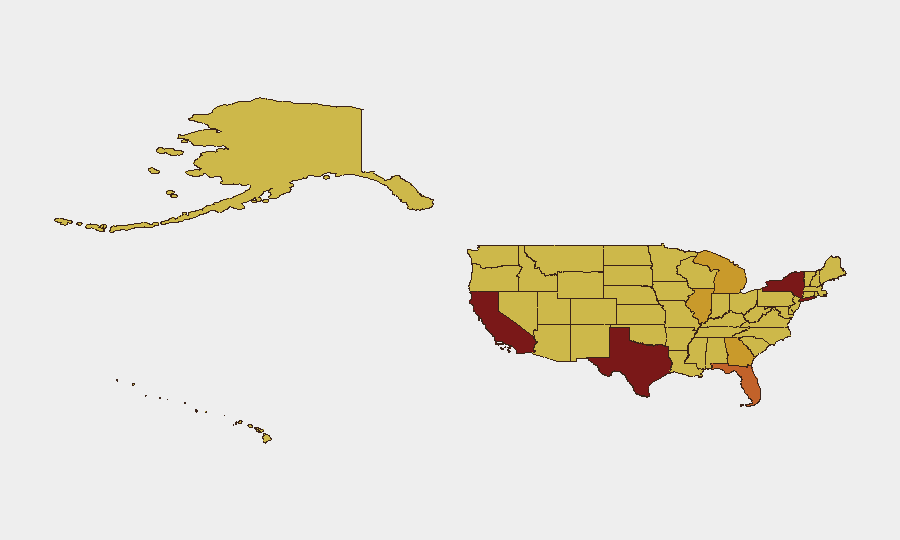
The United States faces an elevated composite threat environment (rank #13 globally, score 88) driven by concurrent cyber infrastructure vulnerabilities, active foreign threat actor campaigns, and ongoing political friction at federal and state levels. Critical systems—including operational technology, communications platforms, and healthcare networks—show active exploitation or compromise within the last 48 hours. The highest-risk states (California, Texas, New York) are experiencing compounded threats from both cyber and political/civil disruption signals, with no immediate de-escalation indicated.
Key Developments
- July 26 – Nationwide Cyber / Critical Infrastructure: CISA, FBI, and NSA issued a joint urgent advisory identifying active Iranian-affiliated cyber targeting of exposed operational technology devices and PLCs, with specific indicators of compromise. Risk of disruption to utilities, manufacturing, and safety-critical systems is elevated.
- July 26 – Nationwide Cyber / Law Enforcement Infrastructure: DHS is investigating a breach of a U.S. government information-sharing network used by agencies and security partners, potentially degrading threat-intelligence distribution and situational awareness across federal and local responders.
- July 26 – Nationwide Cyber / Enterprise Systems: Cisco confirmed active exploitation of a critical vulnerability in Unified Communications Manager, affecting voice and collaboration platforms across U.S. enterprises and public-sector organizations.
- July 26 – Nationwide Cyber / Remote Support Infrastructure: A maximum-severity vulnerability in SimpleHelp remote-support software is under active exploitation, enabling unauthorized remote access to IT infrastructure in small and mid-sized U.S. organizations.
- July 26 – Nationwide Cyber / Healthcare: AdaptHealth disclosed a data breach of patient medical equipment and services records, continuing a pattern of healthcare-sector targeting by cyber actors.
- July 26 – Nationwide Cyber / Law Enforcement Operations: The FBI disrupted a large residential proxy botnet network (NetNut), seizing hundreds of domains used for credential theft and fraud—indicating ongoing law-enforcement focus on cybercriminal infrastructure.
- July 26 – Federal Legal: The U.S. Supreme Court ruled that geofence warrant requirements apply, restricting warrantless mass-location tracking by law enforcement—an operational constraint on digital surveillance methodology.
- July 25–27 – Federal Political: Signal data reflects rejection by Congress and the Supreme Court against executive action, plus disapproval from state actors (South Carolina, Cuba-Washington tensions), indicating elevated institutional and state-level friction.
Highest-Risk Areas
California (91.6) and Texas (91) dominate the risk ranking, followed closely by New York (89.4), driven by their scale, critical infrastructure density, and concentration of federal/state political activity. These three states account for significant portions of U.S. operational technology, financial services, and government decision-making. Secondary elevation in Florida, Illinois, Georgia, and Michigan reflects similar infrastructure concentration and emerging political/civil signals. Risk is not geographically siloed—cyber threats to OT and communications affect nationwide operations, while federal-level political friction reverberates across all high-population states.
How GeoBit Would Assist
Security teams should deploy Intel Sweep and OSINT fusion to corroborate emerging Iranian threat-actor indicators, combined with AOI Monitoring & Early Warning on critical facilities in top-risk states to detect anomalous network or access patterns. Network & Actor Analysis and Shodan-based asset reconnaissance would identify exposed OT and remote-support infrastructure specific to each organization's footprint, enabling rapid patching prioritization. Continuous sentiment & temporal analysis on federal and state-level political signals allows duty-of-care teams to anticipate operational disruption windows.
7-Day Outlook
The cyber threat landscape will remain acute through early August, with Iranian and cybercriminal exploitation of newly disclosed vulnerabilities (Cisco, SimpleHelp) expected to continue at scale. Federal institutional friction and state-level disapproval signals suggest heightened risk of policy disruption and uncoordinated responses, potentially delaying critical infrastructure resilience efforts. Expect sustained targeting of healthcare, utilities, and communications sectors, with elevated likelihood of service degradation in high-risk states.
Highest-Risk Areas — Ranked
| # | State / Region | Risk |
|---|---|---|
| 1 | California | 91.6 |
| 2 | Texas | 91 |
| 3 | New York | 89.4 |
| 4 | Florida | 73.9 |
| 5 | Illinois | 72.9 |
| 6 | Georgia | 72 |
| 7 | Michigan | 71.6 |
| 8 | Wisconsin | 70.7 |
| 9 | Washington | 70.2 |
| 10 | Maine | 70.1 |
| 11 | Pennsylvania | 69.8 |
| 12 | South Carolina | 69.6 |
Sources
Previous Daily Briefs
A new United States brief is written every day — each with its own risk map and downloadable CSV. Here's the last week; use the calendar to go further back.
📅 Browse every day by calendar →
Highlighted days have a brief. Tap a day for that day's map & analysis, or “csv” for that day's dataset ($5).
Atlas — our AI intelligence desk — emails them this snapshot personally. Nothing else, no list.