Situation Summary
Angola remains a moderate composite threat (rank #45 globally, score 40), with civil unrest as the primary driver but no tracked escalation events in the past 24–48 hours. Current developments center on political tension and alleged police brutality against opposition gatherings, coupled with recent recovery from a significant cyberattack on national telecommunications infrastructure. The security environment is characterized by localized instability in resource-rich eastern and northeastern provinces rather than nationwide instability, though opposition-police friction poses recurring low-to-moderate risk in urban centers.
Key Developments
- Luanda, 20 August 2026: UNITA opposition party filed criminal complaints against National Police leadership and Uíge provincial governor for alleged unlawful violence against opposition supporters during an 8 August gathering, citing injuries to women and children and warrantless occupation of party premises. This represents legal escalation of a documented mid-August incident and signals ongoing political-security friction.
- Uíge Province, 20 August 2026: UNITA publicly reiterated allegations that its supporters were attacked without provocation during a peaceful assembly, with dozens injured. The party's continued public statements and legal action indicate sustained tension between opposition and security forces in this region.
- Nationwide (telecommunications), 20–21 August 2026: Unitel announced restoration of full telecommunications services following a cyberattack-induced blackout lasting over three weeks. Service recovery reduces immediate comms-dependency risk but confirms critical infrastructure vulnerability and recent successful targeting of Angola's telecom backbone.
- Implied context (since 8 August): Police response to opposition political assembly in Uíge resulted in reported tear gas and rubber-bullet injuries. While the incident itself predates the 48-hour window, the legal complaints and public statements are current and indicate unresolved political-security friction that may trigger further protests or police responses.
Highest-Risk Areas
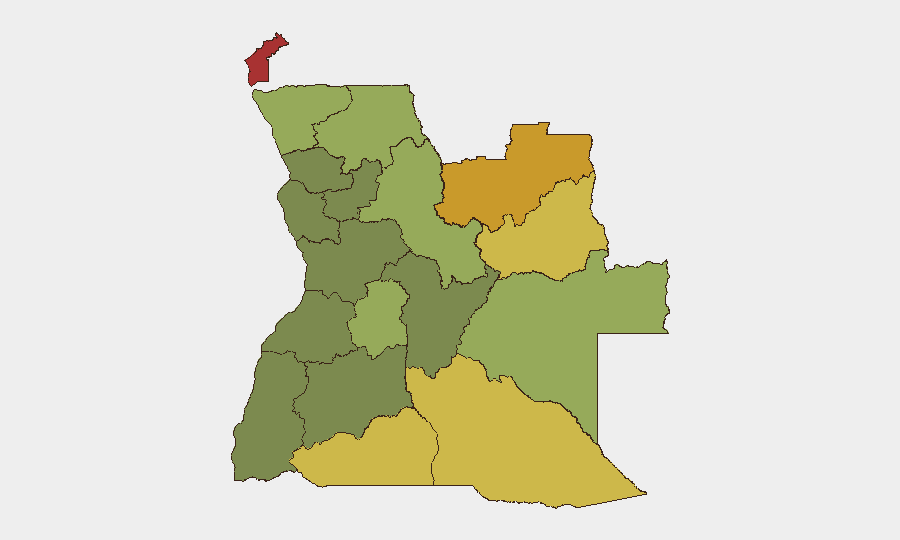
Cabinda Province (risk 78) and the Lunda Norte/Sul cluster (72, 68) dominate Angola's sub-national threat profile, driven by long-standing resource-competition dynamics, armed-group activity, and border instability. Cuando Cubango, Cunene, and Moxico provinces (64, 62, 58) extend this eastern arc of elevated risk. In the near term, however, *urban* political risk concentrates in Uíge Province (risk 48) and Luanda due to opposition-security-force friction; these lower composite scores mask acute tactical risk around opposition gatherings and police operations. Eastern diamond and oil provinces remain higher-risk for kidnapping, armed robbery, and organized crime; western urban centers face episodic protest and police-crowd confrontation.
How GeoBit Would Assist
Security teams should deploy AOI Monitoring & Early Warning on Uíge Province and Luanda to track opposition announcements, police activities, and gathering notices; coupled with OSINT Fusion & Corroboration (X/Twitter, Telegram, local media sentiment analysis) to detect early signals of planned protests or police mobilization. Intel Sweep and multi-language search would capture ongoing political and judicial developments in real time. For asset protection in eastern provinces, Conflict & Military analysis and Network & Actor Analysis provide visibility into armed groups and criminal networks; Routing & Network Analysis enables contingency-travel planning around high-risk zones.
7-Day Outlook
No imminent escalation is signaled, but political tensions remain volatile. UNITA's criminal complaints may prompt judicial hearings or public responses by the government, potentially triggering renewed opposition mobilization. Telecommunications restoration reduces one acute infrastructure risk but leaves Angola's cyber-security posture exposed. Eastern provinces will continue to warrant elevated duty-of-care protocols; opposition activity in Luanda and provincial capitals should be monitored for potential police responses.
Highest-Risk Areas — Ranked
| # | State / Region | Risk |
|---|---|---|
| 1 | Cabinda Province | 78 |
| 2 | Lunda Norte Province | 72 |
| 3 | Lunda Sul Province | 68 |
| 4 | Cuando Cubango Province | 64 |
| 5 | Cunene Province | 62 |
| 6 | Moxico Province | 58 |
| 7 | Zaire Province | 54 |
| 8 | Huambo Province | 50 |
| 9 | Uíge Province | 48 |
| 10 | Malanje Province | 42 |
| 11 | Bié Province | 35 |
| 12 | Huíla Province | 32 |
Sources
Previous Daily Briefs
A new Angola brief is written every day — each with its own risk map and downloadable CSV. Here's the last week; use the calendar to go further back.
- August 19, 2026
- August 17, 2026
- August 15, 2026
- August 13, 2026
- August 11, 2026
- August 9, 2026
- August 8, 2026
📅 Browse every day by calendar →
Highlighted days have a brief. Tap a day for that day's map & analysis, or “csv” for that day's dataset ($5).
Atlas — our AI intelligence desk — emails them this snapshot personally. Nothing else, no list.