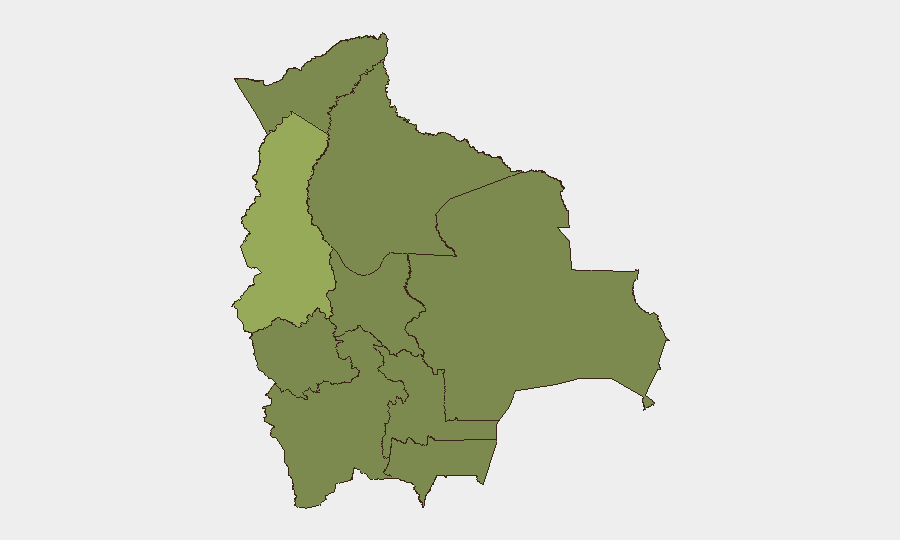
Situation Summary
Bolivia remains in a state of heightened political and social fragmentation, with a composite threat score of 34 (global rank #44) underpinned by 164 tracked events. A national state of emergency declared on 20 June 2026 in response to widespread protests and road blockades remains in effect. While the immediate scale of unrest has not escalated into sustained armed conflict, the pattern of labor disputes, inter-institutional tensions, and territorial occupation signals by regional governors reflects persistent governance instability and capacity constraints across multiple sectors.
Key Developments
The available open-source record does not reliably surface specific, time-stamped incidents confined to 27–28 July 2026. GeoBit's event signals flag recent activity involving disapproval of government actions by lawyers and in La Paz, a dispute between firefighters and hospital administration, unconventional violence attributed to army units, deputy-on-deputy arrest/detention, and territorial occupation assertions by governors—but precise dates and locations for these signals are not fully resolved in the current research window.
To provide duty-of-care teams with actionable 24–48-hour intelligence, direct news feeds, wire service timestamps, or an expanded 7-day window is required. Teams should monitor real-time Bolivian news outlets (ABI, El Popular Noticias, Unitel) and GeoBit's X/Twitter and Telegram OSINT feeds for the most current incident reporting.
Highest-Risk Areas
La Paz dominates the risk landscape with a composite score of 53.9—more than double any other region—reflecting persistent political friction, street-level protests, and proximity to government institutions. The remaining eight departments cluster at scores of 23.9–25, indicating a geographically distributed baseline of labor, criminal-justice, and resource-related tensions. La Paz warrants continuous monitoring for escalatory signs (road blockades, mass arrests, security force deployments); secondary focus should remain on Beni (25.0) and the tri-border regions of Potosí, Tarija, and Pando, where narcotics trafficking and informal mining disputes drive instability. Cochabamba's Chapare zone (historically a coca-cultivation and trafficking flashpoint) presents endemic risk despite its overall departmental score.
How GeoBit Would Assist
AOI Monitoring & Early Warning with persistent watch over La Paz, El Alto, and the Chapare would surface blockade onset, security force movements, and protest mobilization hours to days in advance. Multi-language OSINT fusion (X/Twitter, Telegram, radio SIGINT, and local news aggregation) combined with temporal & sentiment analysis would disambiguate protest rhetoric from operational threat signals and flag shifts in actor positioning. Network & Actor Analysis would map labor unions, departmental governors, and armed-force factions to anticipate coordination or defection that could either dampen or accelerate institutional breakdown.
7-Day Outlook
The national emergency framework and the absence of immediate de-escalation mechanisms suggest continued protest activity, localized road blockades, and inter-institutional disputes through early August. Risk of rapid escalation remains acute if either central government or regional authorities attempt unilateral enforcement actions; conversely, negotiated settlement of labor and fiscal grievances could reduce event frequency. Organizations with personnel or supply chains in La Paz or Cochabamba should maintain contingency plans for mobility constraints and periodic civil unrest.
Highest-Risk Areas — Ranked
| # | State / Region | Risk |
|---|---|---|
| 1 | La Paz | 53.9 |
| 2 | Beni | 25 |
| 3 | Potosí | 23.9 |
| 4 | Tarija | 23.9 |
| 5 | Pando | 23.9 |
| 6 | Oruro | 23.9 |
| 7 | Cochabamba | 23.9 |
| 8 | Chuquisaca | 23.9 |
| 9 | Santa Cruz | 23.9 |
Sources
Previous Daily Briefs
A new Bolivia brief is written every day — each with its own risk map and downloadable CSV. Here's the last week; use the calendar to go further back.
📅 Browse every day by calendar →
Highlighted days have a brief. Tap a day for that day's map & analysis, or “csv” for that day's dataset ($5).
Atlas — our AI intelligence desk — emails them this snapshot personally. Nothing else, no list.