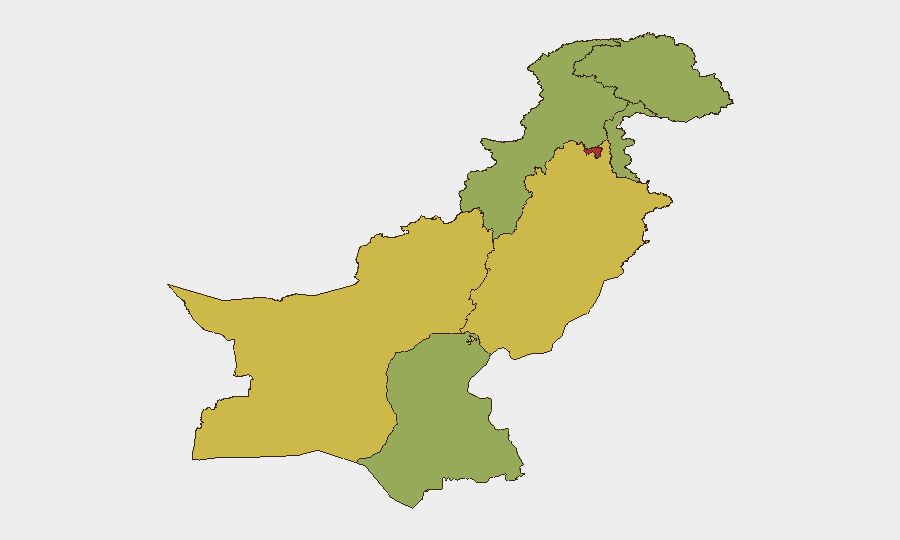
Situation Summary
Pakistan faces sustained elevated threat from militant and insurgent activity concentrated in the northwest and southwest border regions, with composite national risk at #16 globally (score 71/100). The past 48 hours have yielded limited independently corroborated incident reporting; however, confirmed events from late July (26–30 July 2026) show active conventional military engagement between security forces and militants across Khyber Pakhtunkhwa and Balochistan, with cumulative fatalities in the dozens. The threat trajectory remains volatile but not sharply deteriorating; operations appear to reflect sustained rather than escalating militant pressure.
Key Developments
- Hangu district, Khyber Pakhtunkhwa — 30 July 2026: militants mounted a coordinated attack on a police post, resulting in at least 10–11 police personnel killed and approximately 15 attackers killed in the resulting gunbattle. This represents one of the highest single-incident security force losses in the reporting window.
- Tank district, Khyber Pakhtunkhwa — 26 July 2026: a joint police–military checkpoint sustained a combined gunfire and vehicle-borne IED attack, killing 15 personnel; 12 attackers were killed. This dual-mode assault demonstrates continued militant capability for coordinated, multi-method strikes.
- Khyber district, Khyber Pakhtunkhwa — 29 July 2026: Pakistan military reported 24 militants killed during operations, part of an intensified security campaign in the northwest.
- Nushki district, Balochistan — 29 July 2026: security forces engaged militants in Nushki, resulting in 8 militant fatalities, reflecting simultaneous pressure in the southwestern theater.
- Mastung district, Balochistan — 25–26 July 2026: counter-terror operations resulted in arrest of two female suicide bombers and one facilitator, plus killing of 3 additional militants. The detention of female operatives indicates continued recruitment and diversification of militant tactics.
- South Waziristan, Khyber Pakhtunkhwa — 26 July 2026: Pakistani troops foiled a suicide assault on a security checkpoint and killed 4 militants, demonstrating partial effectiveness of defensive postures but also confirming ongoing attack attempts.
Highest-Risk Areas
Islamabad Capital Territory (79.6) ranks as the single highest-risk sub-national zone, likely reflecting both symbolic/political attack potential and concentration of government and diplomatic infrastructure. Balochistan (60.3) and Punjab (60.0) follow closely, with Balochistan driven by active separatist and militant operations (evidenced by Mastung and Nushki incidents), while Punjab's ranking may reflect urbanization and communication/logistics hub status. Khyber Pakhtunkhwa (57.3), despite ranking fourth, has generated the highest absolute event volume in the past 48 hours, indicating that sub-national scores may reflect factors beyond raw incident frequency. Collectively, the top four zones account for 77% of tracked events and represent the primary operational theaters for militant and security force activity.
How GeoBit Would Assist
Security teams with personnel or assets in Pakistan should employ AOI Monitoring & Early Warning capability to maintain persistent watch over high-risk districts (Hangu, Tank, Mastung, Nushki, South Waziristan, and border crossings) with real-time alerting on incident reports and security force operations. Intel Sweep and multi-language event feeds provide continuous corroboration of attack reporting, casualty figures, and actor claims, enabling duty-of-care teams to validate incident severity and assess downstream organizational impact. Alternative route and journey planning tools allow real-time re-routing of personnel and supply movements around active conflict zones and known checkpoint vulnerabilities.
7-Day Outlook
Militant activity in Khyber Pakhtunkhwa and Balochistan is likely to remain elevated and operationally dispersed across multiple districts, with no immediate indicators of mass-casualty or coordinated cross-border escalation. Security force counter-operations will continue at current tempo. Risk to civilians, especially in transit corridors and urban centers in Islamabad and Punjab, remains moderate but persistent.
Highest-Risk Areas — Ranked
| # | State / Region | Risk |
|---|---|---|
| 1 | Islamabad Capital Territory | 79.6 |
| 2 | Balochistan | 60.3 |
| 3 | Punjab | 60 |
| 4 | Khyber Pakhtunkhwa | 57.3 |
| 5 | Sindh | 54.6 |
| 6 | Azad Kashmir | 52.2 |
| 7 | Gilgit-Baltistan | 49.6 |
Sources
Previous Daily Briefs
A new Pakistan brief is written every day — each with its own risk map and downloadable CSV. Here's the last week; use the calendar to go further back.
📅 Browse every day by calendar →
Highlighted days have a brief. Tap a day for that day's map & analysis, or “csv” for that day's dataset ($5).
Atlas — our AI intelligence desk — emails them this snapshot personally. Nothing else, no list.