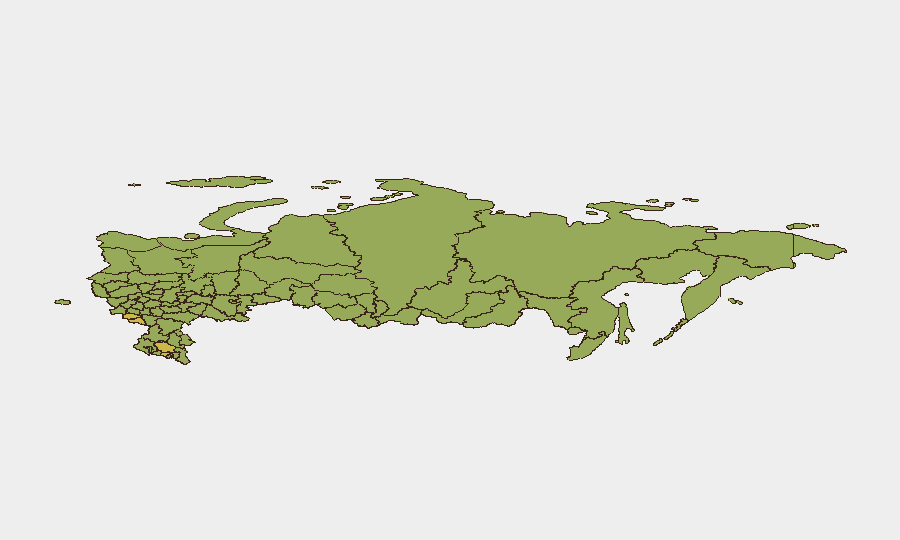
Situation Summary
Russia's composite threat score remains elevated at 82 (rank #12 globally), driven by sustained cross-border military activity, civilian infrastructure targeting, and emerging fuel-system disruptions. Moscow dominates regional risk (87.3), followed by North Caucasus and border oblasts where conventional military operations and strike activity cluster. Trajectory remains volatile with no de-escalation indicators; civilian impact in major population centers is accelerating.
Key Developments
- Krasnodar Krai logistics strike (2026-07-23): Ukrainian drone strikes hit Wildberries distribution facilities in Krasnodar, Nevinnomyssk, and Armavir, causing fires, evacuations, injuries, and at least one reported worker fatality. Logistics and supply-chain resilience now under direct threat.
- Naval losses claimed (2026-07-23): Ukrainian forces reported strikes on 13 Russian vessels in Black Sea and Sea of Azov operations over preceding 48 hours; operational damage assessment pending independent confirmation.
- Belgorod Oblast civilian casualties (2026-07-20, ongoing pattern): Border regions (Belgorod, Bryansk, Kursk) reported four civilian deaths and ~30 injuries in overnight strikes; pattern consistent with sustained cross-border targeting.
- Moscow region infrastructure damage (2026-07-20): Drone attacks on Podolsk, Domodedovo, and Odintsovo districts damaged civilian infrastructure; Moscow region authorities confirmed 10+ wounded.
- National fuel shortage (2026-07-20–25, trend): Gasoline scarcity attributed to refinery and energy-facility strikes; gas-station queues and localized fuel disruptions reported across multiple regions, impacting civilian mobility and business continuity.
- Saint Petersburg threat signal (2026-07-24): Platform detected "Threaten" signal associated with Saint Petersburg; specific incident or target under analysis.
- Kaluga rejection signal (2026-07-23): Regional authority or entity issued rejection statement; context under clarification.
Highest-Risk Areas
Moscow (87.3) remains the primary risk driver due to population density, infrastructure concentration, and repeated targeting. North Caucasus regions—Kabardino-Balkaria (67.6) and Stavropol Krai (64.2)—face compounded risks from proximity to active military operations and historical instability. Russia's western and southwestern borders—Kursk (63.4), Belgorod (62.3), and Rostov (59.2)—show sustained conventional-military and civilian-targeting activity, with fuel and logistics infrastructure increasingly vulnerable. Saint Petersburg (64.4) has escalated in both official threat level and recent signal activity, warranting heightened monitoring.
How GeoBit Would Assist
Intel Sweep and OSINT fusion enable real-time correlation of cross-border military signals, naval losses, and civilian-impact claims across Telegram, X, and open sources to confirm damage and casualty reports. AOI Monitoring & Early Warning on Moscow, Belgorod, Kursk, and Krasnodar—combined with Satellite & Imagery analysis—provides persistent, automated detection of infrastructure strikes, fuel-facility damage, and displacement activity before mainstream reporting. Conflict & Military force-structure and weapons-capability tracking, paired with Maritime tracking, supports logistics-chain risk assessment (refineries, ports, warehouses) and predictive modeling of next-target categories for duty-of-care planning.
7-Day Outlook
Cross-border strike intensity is expected to remain elevated or increase, with fuel-system degradation and civilian infrastructure targeting likely to persist. Moscow and border oblasts will remain primary flashpoints; supply-chain and energy disruptions should be factored into contingency planning for any corporate or staff operations. No major policy or military shift is indicated; escalation risk remains moderate to high.
Highest-Risk Areas — Ranked
| # | State / Region | Risk |
|---|---|---|
| 1 | Moscow | 87.3 |
| 2 | Kabardino-Balkaria | 67.6 |
| 3 | Saint Petersburg | 64.4 |
| 4 | Stavropol Krai | 64.2 |
| 5 | Kursk Oblast | 63.4 |
| 6 | Belgorod Oblast | 62.3 |
| 7 | Astrakhan Oblast | 59.4 |
| 8 | Krasnodar Krai | 59.2 |
| 9 | Rostov Oblast | 59.2 |
| 10 | Tula Oblast | 58.4 |
| 11 | Primorsky Krai | 58.3 |
| 12 | Kaliningrad | 58.2 |
Sources
Previous Daily Briefs
A new Russia brief is written every day — each with its own risk map and downloadable CSV. Here's the last week; use the calendar to go further back.
📅 Browse every day by calendar →
Highlighted days have a brief. Tap a day for that day's map & analysis, or “csv” for that day's dataset ($5).
Atlas — our AI intelligence desk — emails them this snapshot personally. Nothing else, no list.