Situation Summary
Pakistan faces sustained militant pressure across northwestern and southwestern theatres, with security forces engaged in intensive counter-terror operations yielding significant casualty counts but indicating no abatement in attack frequency or sophistication. The last 48 hours have seen coordinated drone-assisted ambushes on police checkpoints, targeted killings of senior law enforcement, and abductions of civilian workers, alongside security sweeps that have killed dozens of militants. Islamabad Capital Territory carries the highest composite risk (83.8), but operational threat density is concentrated in Khyber Pakhtunkhwa and Balochistan, where militant cells retain capability to execute complex strikes and continue targeting infrastructure and personnel corridors. Trajectory remains volatile with curfews, mobility restrictions, and escalating tactical sophistication among insurgent groups.
Key Developments
- Hangu district, Khyber Pakhtunkhwa (night 29 July 2026): Militant forces executed drone-assisted IED attack on Khazina Banda police checkpoint, killing at least 10–11 officers and 15 militants, with 25+ officers wounded following hours of combat. This represents a significant tactical innovation in checkpoint targeting.
- Khyber district, Khyber Pakhtunkhwa (28–29 July 2026): Security forces conducted intelligence-led operations killing 24 militants and recovering weapons and IEDs; combined with Nushki engagement, 32 militants killed across both districts within 24 hours per ISPR.
- Nushki district, Balochistan (prior to 29 July 2026): Intense firefight resulted in 8 militant deaths and destruction of weapons caches; followed by three-day curfew imposed by provincial authorities.
- Mastung district, Balochistan (late July 2026): Indefinite curfew maintained in parts of Mastung following repeated attacks on checkpoints and travelers along Quetta–Karachi highway corridor; movement restrictions now in effect across both Nushki and Mastung.
- Kech district near Turbat, Balochistan (late July 2026): Armed group abducted six workers from Punjab and Khyber Pakhtunkhwa at Klatuk (32 km from Turbat) and killed one laborer; indicates targeting of non-local labor cohorts.
- Barkhan district, Balochistan (late July 2026): Deputy Superintendent of Police Mureed Bugti intercepted and abducted en route from Rakhni to Barkhan; both DSP and gunman subsequently shot dead, signalling deliberate targeting of senior law-enforcement personnel.
Highest-Risk Areas
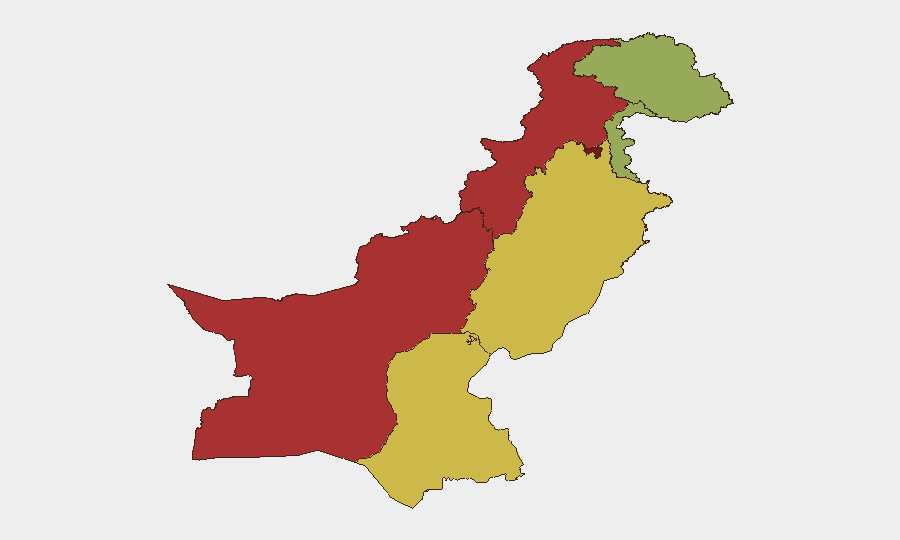
Islamabad Capital Territory ranks highest (83.8) largely due to concentration of government infrastructure, but operational threat severity is concentrated in Khyber Pakhtunkhwa (77.1) and Balochistan (76.7), where recent events cluster. Khyber Pakhtunkhwa has experienced drone-augmented attacks and multi-hour combat incidents; Balochistan shows persistent targeting of transport corridors, checkpoints, and both civilian workers and senior officers. Sindh and Punjab rank lower (70.3 and 68.5 respectively) but remain within elevated-risk bands. The geographic pattern suggests militant networks retain distributed cells capable of simultaneous or near-simultaneous strikes across multiple districts and provinces.
How GeoBit Would Assist
Security and duty-of-care teams should deploy AOI (Area-of-Interest) Monitoring & Early Warning on Quetta–Karachi corridor, Hangu, Khyber, and Barkhan districts to track curfew announcements, checkpoint incidents, and movement restrictions in near real-time. Network & Actor Analysis combined with OSINT fusion (X/Telegram feeds, regional media, ISPR statements) would enable continuous tracking of militant group claims, targeting patterns, and tactical innovations (e.g., drone-IED integration). Routing & Network Analysis capabilities allow security teams to model alternative travel corridors and assess risk dynamism on key personnel-transit routes, particularly in Balochistan.
7-Day Outlook
Expect continued security sweeps and militant counter-strikes across Khyber Pakhtunkhwa and Balochistan through early August, with curfews likely extending or localizing further. Checkpoint and convoy-ambush incidents remain probable; personnel movement on provincial highways should assume elevated interdiction risk. No near-term de-escalation signal is evident in operational tempo or targeting patterns.
Highest-Risk Areas — Ranked
| # | State / Region | Risk |
|---|---|---|
| 1 | Islamabad Capital Territory | 83.8 |
| 2 | Khyber Pakhtunkhwa | 77.1 |
| 3 | Balochistan | 76.7 |
| 4 | Sindh | 70.3 |
| 5 | Punjab | 68.5 |
| 6 | Azad Kashmir | 56.6 |
| 7 | Gilgit-Baltistan | 53.8 |
Sources
Previous Daily Briefs
A new Pakistan brief is written every day — each with its own risk map and downloadable CSV. Here's the last week; use the calendar to go further back.
📅 Browse every day by calendar →
Highlighted days have a brief. Tap a day for that day's map & analysis, or “csv” for that day's dataset ($5).
Atlas — our AI intelligence desk — emails them this snapshot personally. Nothing else, no list.