Situation Summary
Angola remains at global rank #48 with a composite threat score of 40, reflecting a fragmented but manageable security environment absent large-scale armed conflict or major civil unrest during the current week. However, labor unrest, infrastructure disruptions, and public-health concerns are creating operational friction and travel risks, particularly in resource-extraction and border zones. The country's trajectory is one of localized tension rather than systemic instability, though cascading labor actions and infrastructure vulnerabilities warrant close monitoring through October.
Key Developments
- Benguela Province, Lobito (Sonaref refinery site) – 11 September 2026
An indefinite strike by hundreds of construction workers began over wage demands (6× increase sought, from ~100,000 to 600,000 kwanzas/month). Operated by Sonangol and CNCEC, the site faces disruption risk and potential police intervention if tensions escalate.[12]
- National – Teachers' union strike announcement – 10 September 2026
Sinprof announced a multi-phase nationwide strike from 21 September to 15 October 2026, covering general, technical, and adult education sectors after failed wage negotiations.[9] Strike onset is imminent (within days of brief publication).
- National – Internet infrastructure disruption – 10 September 2026
Angola experienced a one-hour BGP routing disruption (07:05–08:05 UTC) affecting ~14% of median BGP visibility.[2] Cause remains unattributed (technical, misconfiguration, or malicious); connectivity was restored. Highlights cyber/infrastructure vulnerability for connectivity-dependent organizations.
- Cabinda Province – Mpox outbreak scale – as of 9 September 2026
Cabinda recorded 264 confirmed cases, 2 deaths, and 37 hospitalized patients, the highest provincial caseload in Angola.[6] Affects travel-health risk and may trigger movement restrictions or public anxiety.
- Cunene Province (border with Namibia) – Child and labor trafficking – 9 September 2026
Provincial governor publicly denounced a clandestine cross-border trafficking network recruiting children and adults in southern Angola for exploitative agricultural labor in Namibia.[4] Signals ongoing human-trafficking and labor-exploitation risk in the border region.
- Cuando Cubango Province – Road-safety political response – 9 September 2026
Opposition parties UNITA and PRA-JA Servir Angola demanded tougher transport-safety measures following a 6 September bus crash in Caiundo that killed 4 and injured 24.[8] Reflects infrastructure and transport-safety concerns; may prompt regulatory enforcement.
- Cabinda environs – Wildfire activity – 14 September 2026
A severe active fire cluster was detected via satellite (FIRMS) approximately 46 km northeast of Cabinda.[14] Potential impacts on rural communities, cross-border zones, air quality, and transport routes remain unquantified.
- National – IMF post-financing assessment – 9 September 2026
IMF mission completed review of Angola's economic performance.[15] Underscores ongoing fiscal adjustment that intersects with labor unrest and public expectations on wages and social spending.
Highest-Risk Areas
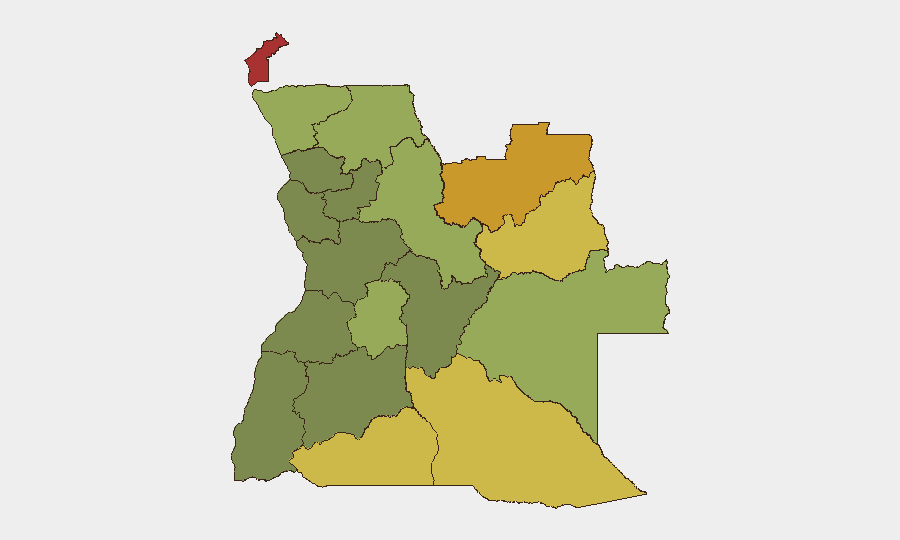
Cabinda, Lunda Norte, and Lunda Sul provinces dominate the sub-national ranking (scores 78, 72, and 68 respectively), driven by historical resource-extraction tensions, trafficking networks, and public-health emergencies. Cuando Cubango and Cunene (scores 64 and 62) reflect border instability, labor exploitation, and infrastructure gaps. Eastern and southern frontier zones carry elevated cross-border, trafficking, and environmental fire risks; central provinces (Huambo, Huíla) show lower but non-negligible vulnerability tied to transport and labor dynamics.
How GeoBit Would Assist
Intel Sweep and OSINT Fusion would corroborate labor-strike timelines and escalation signals across multiple sources (news, social media, union communications) to forewarn of operational disruption windows. AOI Monitoring & Early Warning on high-risk provinces (Cabinda, Lunda Norte, Cunene border) would provide persistent alerting on trafficking, fire, health, and protest activity. Routing & Network Analysis would support alternative journey planning for personnel and supply chains during strike periods or infrastructure outages.
7-Day Outlook
The teachers' strike formally begins 21 September, likely triggering school closures and localized protest activity across multiple provinces through mid-October. Refinery labor unrest may escalate or spread to other resource sites if wage grievances remain unaddressed. Border and environmental risks (trafficking, fire) will persist; health concerns in Cabinda warrant continued travel-health advisories.
Highest-Risk Areas — Ranked
| # | State / Region | Risk |
|---|---|---|
| 1 | Cabinda Province | 78 |
| 2 | Lunda Norte Province | 72 |
| 3 | Lunda Sul Province | 68 |
| 4 | Cuando Cubango Province | 64 |
| 5 | Cunene Province | 62 |
| 6 | Moxico Province | 58 |
| 7 | Zaire Province | 54 |
| 8 | Huambo Province | 50 |
| 9 | Uíge Province | 48 |
| 10 | Malanje Province | 42 |
| 11 | Bié Province | 35 |
| 12 | Huíla Province | 32 |
Sources
Previous Weekly Briefs
A new Angola brief is written every Monday, covering the week — each with its own risk map and downloadable CSV. Use the calendar to go further back.
- September 8, 2026
- September 2, 2026
- August 31, 2026
- August 29, 2026
- August 27, 2026
- August 25, 2026
- August 23, 2026
📅 Browse past briefs by calendar →
Highlighted days have a brief. Tap a day for that day's map & analysis, or “csv” for that day's dataset ($5).
Atlas — our AI intelligence desk — emails them this snapshot personally. Nothing else, no list.