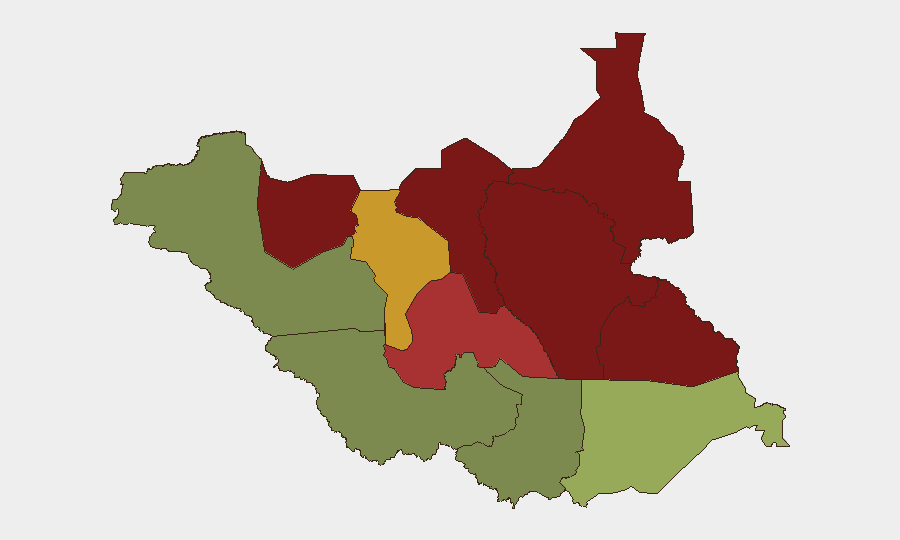
Situation Summary
South Sudan remains at elevated civil unrest risk (ranked #32 globally, composite threat score 65), with violence, displacement, and political instability continuing ahead of scheduled elections. A UN peacekeeper ambush in Jonglei State on 2026-09-08 underscored active armed threat in key operational areas, while the UN Commission on Human Rights reported ongoing killings, sexual violence, and arbitrary detention. International travel advisories remain at maximum restriction, and the UN Security Council maintained focused attention on governance and security conditions during the week.
Key Developments
- Jonglei State, 2026-09-08 — Two UN peacekeepers killed and others injured in a patrol ambush, confirming active armed threat to international personnel in one of the country's highest-risk zones.
- Bentiu IDP Camp, Unity State, 2026-09-07 to 2026-09-26 — A formal justice mechanism began operations to adjudicate sexual and gender-based violence, drug offenses, and gang violence cases, indicating structural security gaps in displacement settings requiring judicial intervention.
- UN Commission on Human Rights, 2026-09-10 — Warned of continuing killings, displacement, sexual violence, and arbitrary detention, with violence worsening ahead of elections and signaling deteriorating political stability.
- South Sudan–Uganda Border, 2026-09-08 — South Sudan and Uganda signed an MOU on outbreak response and cross-border surveillance, reflecting ongoing need for coordinated border security and disease monitoring amid broader instability.
- UN Security Council, 2026-09-11 — Council met on South Sudan's situation (meeting 10220th) and renewed attention to sanctions and security conditions, underscoring international concern over governance.
- Canada Travel Advisory, 2026-09-09 — Maintained "avoid all travel" status due to volatile security, armed conflict, inter-ethnic violence, and violent crime, consistent with high-risk assessment.
- Diplomatic Engagement, Juba, 2026-09-11 — South Sudan's foreign minister met China's chargé d'affaires; while routine, signals continued state-level engagement despite instability and may indicate diplomatic positioning ahead of elections.
Highest-Risk Areas
Unity, Jonglei, and Upper Nile states drive the national threat profile, with composite risk scores of 95, 93, and 88 respectively. Jonglei's recent peacekeeper ambush and ongoing armed-group activity make it an acute threat zone for any international personnel or supply operations. Unity's IDP camp security issues and historical inter-communal violence sustain risk, while Upper Nile's remote geography and armed-group presence compound response challenges. Greater Pibor Administrative Area (risk 87) and Northern Bahr el Ghazal (82) follow, driven by inter-ethnic violence and resource competition. Central Equatoria (risk 35) and Western Equatoria (38) remain comparatively lower-risk but should not be treated as secure for non-essential operations.
How GeoBit Would Assist
Corporate security teams should employ AOI Monitoring & Early Warning on Unity, Jonglei, and Upper Nile states to detect armed activity, displacement patterns, and checkpoint changes near operational sites. OSINT Fusion & Corroboration across multi-language feeds, social media, and radio SIGINT would triangulate incident reports and armed-group communications in real time, reducing lag on ambush and violence alerts. Routing & Network Analysis should be applied to alternative travel corridors and supply-line planning, with Satellite & Imagery Analysis used to assess IDP camp conditions, military deployments, and checkpoint locations near critical infrastructure.
7-Day Outlook
Violence and political tension are likely to remain elevated through the election period, with armed groups and inter-communal actors maintaining operational tempo in the north and northeast. International attention will remain high, and security incidents involving UN personnel or humanitarian staff should be anticipated. Corporate operations in Unity and Jonglei should assume persistent ambush and criminal-diversion risk; lower-risk equatoria zones may see marginal improvements if electoral activities stabilize governance messaging.
Highest-Risk Areas — Ranked
| # | State / Region | Risk |
|---|---|---|
| 1 | Unity | 95 |
| 2 | Jonglei | 93 |
| 3 | Upper Nile | 88 |
| 4 | Greater Pibor Administrative Area | 87 |
| 5 | Northern Bahr el Ghazal | 82 |
| 6 | Lakes | 78 |
| 7 | Warrap | 72 |
| 8 | Ruweng Administrative Area | 68 |
| 9 | Eastern Equatoria | 52 |
| 10 | Western Equatoria | 38 |
| 11 | Central Equatoria | 35 |
| 12 | Western Bahr el Ghazal State | 28 |
Sources
Previous Weekly Briefs
A new South Sudan brief is written every Monday, covering the week — each with its own risk map and downloadable CSV. Use the calendar to go further back.
- September 7, 2026
- September 1, 2026
- August 30, 2026
- August 28, 2026
- August 26, 2026
- August 24, 2026
- August 22, 2026
📅 Browse past briefs by calendar →
Highlighted days have a brief. Tap a day for that day's map & analysis, or “csv” for that day's dataset ($5).
Atlas — our AI intelligence desk — emails them this snapshot personally. Nothing else, no list.