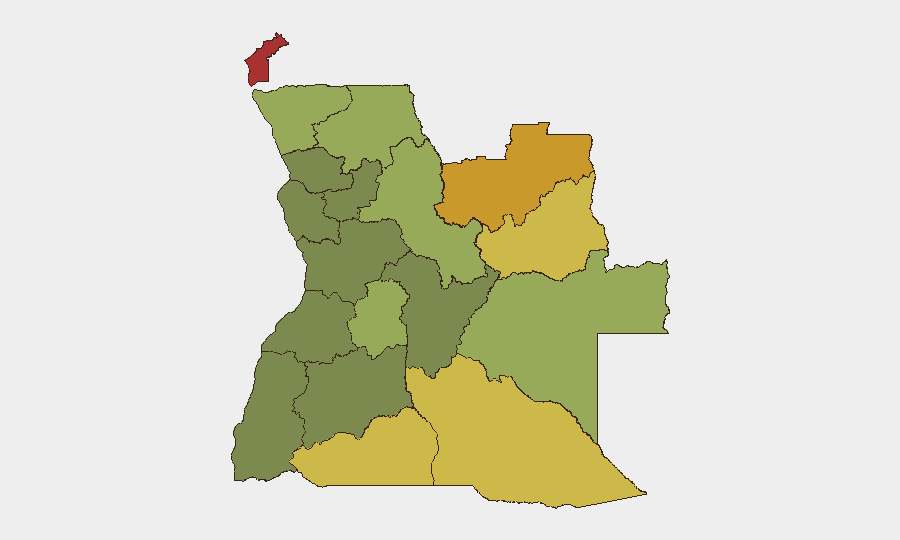
Situation Summary
Angola remains a moderate-risk environment (global rank #48) with no major security incidents in the past week, but emerging labor unrest and police operational tempo are creating near-term friction points. A nationwide justice-sector strike begins 24 September, following an ongoing teachers' strike launched 21 September, while heightened police enforcement operations and documented concerns over crowd-control tactics compound civil-liberties risk in urban centers. The security environment is stable but increasingly subject to labor-driven disruption and administrative friction rather than acute violence.
Key Developments
- National – Justice sector strike announced (19 September, effective 24 September 2026). The Justice Officers' Union (SOJA) announced a nationwide walkout across all justice services, citing three-month arrears in emoluments. Court operations, law enforcement workflows, and dispute resolution will face material disruption across all provinces.[18]
- National – Teachers' strike underway (21 September 2026). The Sinprof teachers' union confirmed multi-phase strike action from 21 September to 15 October across general, technical, and adult education sectors following failed wage negotiations, triggering school closures and localized protest risk around education offices.[20]
- National – Operation "Prolongado Seguro" police enforcement drive (16–22 September 2026). The Angolan National Police launched a nationwide public-order and crime-prevention operation, increasing checkpoints, patrols, and road-safety enforcement across major urban centers (Luanda, Benguela, Huíla) through the extended weekend, tightening inter-provincial travel controls.[26]
- National – Human Rights Watch allegation of violent protest dispersal (published 21 September 2026). HRW accused Angolan police of using heavy-handed tactics to disperse peaceful protesters in recent demonstrations, indicating elevated civil-liberties risk during future labor and political gatherings in major cities, particularly Luanda.[4][25]
- Uíge Province – Sustained health-sector tension (18 September 2026). The population in Uíge continues demanding accountability for maternal deaths at the provincial hospital maternity ward; opposition party UNITA has called for an independent investigation, signaling politicization and renewed demonstration risk.[29]
- National – Security personnel restructuring (17 September 2026). President João Lourenço reassigned 26 generals and admirals across armed forces, National Police, criminal investigation, intelligence, and presidential security apparatus, with operational implications for future civil-unrest response and intelligence-led policing posture.[16]
- Bié Province (Cuito) – Community policing directive (15 September 2026). The National Police Commander-General issued a directive to strengthen community policing in Cuito, signaling official emphasis on crime control and community engagement in this mid-risk province.[30]
- National – Moderate wildfire activity (18 September 2026). UN GDACS satellite data recorded moderate-level wildfire alerts in rural interior areas (approx. –12.232°, 17.821° and –16.046°, 18.528°), with potential secondary impacts on air quality, agriculture, and interior road travel.[9][13][24]
Highest-Risk Areas
Cabinda Province (risk 78) and the Lunda Norte/Sul provinces (72, 68) remain Angola's highest-risk sub-national zones, driven by historical separatist tension, artisanal mining conflicts, and cross-border criminal activity. Cuando Cubango and Cunene provinces (64, 62) face border-security and trafficking pressures linked to regional instability. Risk in these eastern and southeastern border regions substantially exceeds national average; organizations with personnel or assets in these provinces should apply elevated monitoring and contingency protocols.
How GeoBit Would Assist
Security teams should deploy AOI Monitoring & Early Warning to track justice-sector and education labor actions in real time and alert on protest cluster formation in Luanda and provincial capitals. OSINT Sweep and multi-language search capabilities enable tracking of union announcements, police operational updates, and civil-society statements across Portuguese-language and regional media. Routing & Network Analysis supports safe inter-provincial travel planning during heightened checkpoint enforcement and provides alternative routes during road-safety operations.
7-Day Outlook
Labor unrest will intensify through late September as the justice strike begins (24 Sept) concurrent with the ongoing teachers' strike, elevating demonstration and police-response risk in urban centers. Police operational tempo remains elevated through the extended weekend. Wildfire activity and Uíge health-sector tensions pose lower but sustained secondary risks. No escalation to violence is currently indicated, but civil-liberties friction and administrative disruption should be expected.
Highest-Risk Areas — Ranked
| # | State / Region | Risk |
|---|---|---|
| 1 | Cabinda Province | 78 |
| 2 | Lunda Norte Province | 72 |
| 3 | Lunda Sul Province | 68 |
| 4 | Cuando Cubango Province | 64 |
| 5 | Cunene Province | 62 |
| 6 | Moxico Province | 58 |
| 7 | Zaire Province | 54 |
| 8 | Huambo Province | 50 |
| 9 | Uíge Province | 48 |
| 10 | Malanje Province | 42 |
| 11 | Bié Province | 35 |
| 12 | Huíla Province | 32 |
Sources
Previous Weekly Briefs
A new Angola brief is written every Monday, covering the week — each with its own risk map and downloadable CSV. Use the calendar to go further back.
- September 15, 2026
- September 8, 2026
- September 2, 2026
- August 31, 2026
- August 29, 2026
- August 27, 2026
- August 25, 2026
📅 Browse past briefs by calendar →
Highlighted days have a brief. Tap a day for that day's map & analysis, or “csv” for that day's dataset ($5).
Atlas — our AI intelligence desk — emails them this snapshot personally. Nothing else, no list.