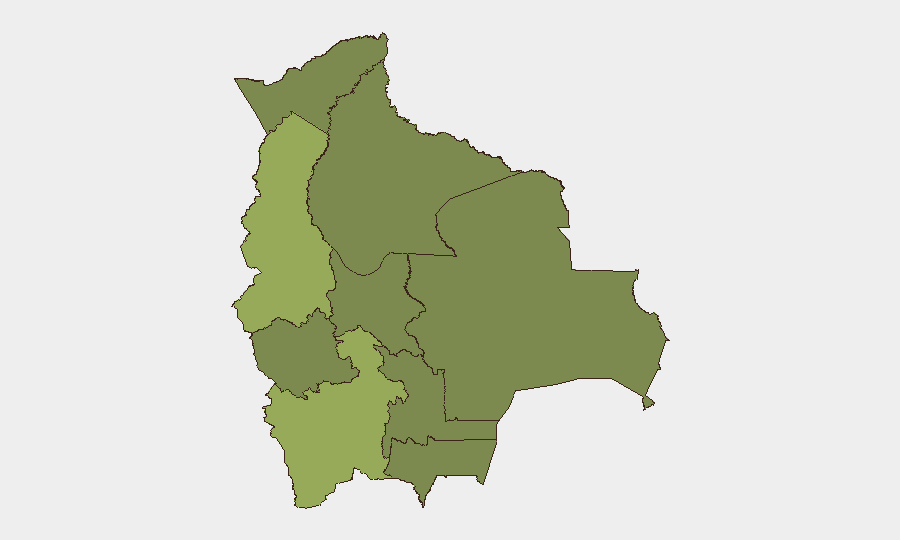
Situation Summary
Bolivia faces a compounding security crisis spanning political instability, violent crime, and infrastructure disruption. A nationwide 53-day road blockade ended in late July, but fuel shortages persist, judicial escalation against former president Evo Morales has resumed, and intra-union violence is fragmenting the protest movement. The national composite threat score of 34 (rank #48 globally) masks sharp regional concentration, with La Paz (53.5) and Potosí (41.3) driving national risk; violent crime against cash handlers, cross-border armed attacks, and road-safety failures are now intersecting with political confrontation.
Key Developments
- La Paz city, 29 July – Leadership of the CSUTCB (national peasant-union confederation) reported an attempted violent takeover of headquarters, resulting in property damage and assaults; signals internal fracturing of the protest coalition that orchestrated the blockade.
- Santa Cruz department, 30 July – A district prosecutor issued a new arrest warrant for former president Evo Morales, charging him with armed uprising, terrorism, and attacks on transport safety related to the blockade campaign; widely interpreted as judicial escalation with high risk of triggering renewed mass mobilization.
- Cochabamba city, 27 July evening–night – Three armed robberies targeting money changers and currency-exchange offices in El Castillo–Sacaba and near the bus terminal resulted in one fatality (three gunshot wounds) and three injuries; police assess the attacks involve separate criminal groups, indicating spike in organized violent crime targeting cash handlers.
- Santa Cruz–Brazil border (San Matías), 28 July night – Armed attack left three dead and one injured; local security attributes incident to cross-border criminal violence, highlighting elevated risk in frontier zones.
- Ichilo (Santa Cruz–Cochabamba highway), 29 July – Road blockade was successfully cleared and traffic normalized, but the incident underscores persistent blockade risk on major inter-departmental routes.
- La Paz and El Alto, 29 July ongoing – Fuel-distribution disruption persists nearly two weeks after end of blockade, with long diesel queues reported at multiple service stations, affecting logistics and supply-chain reliability nationwide.
- Cotoca (Santa Cruz), 29–30 July – Security authorities seized three tanker trucks and arrested a driver and gas-station administrator over alleged diversion of 24,000 liters of fuel; reflects ongoing fuel-smuggling and regulatory-enforcement challenges compounding supply instability.
Highest-Risk Areas
La Paz dominates Bolivia's risk profile (53.5), driven by concurrent political violence (the Morales warrant, CSUTCB headquarters attack, ongoing protest mobilization), and fuel-supply strain affecting essential services and triggering secondary unrest. Potosí (41.3) ranks second, reflecting legacy protest activity and labor-union organizing. Cochabamba (30.7) is now elevated by concentrated armed robbery of financial targets and blockade-related economic disruption. Santa Cruz (23.5) and Pando border zones face cross-border criminal violence and smuggling; while ranked lower in the composite index, frontier violence and fuel diversion represent acute corporate and supply-chain risk.
How GeoBit Would Assist
AOI Monitoring & Early Warning on La Paz (capital, union headquarters, judiciary), Cochabamba (commercial/transport hub), and Santa Cruz–Brazil border zones would detect protest mobilization, arrest-related unrest, and armed-crime clustering in near-real time. Network & Actor Analysis and multi-language OSINT (Telegram, X, radio SIGINT) would track fragmentation within the peasant-union coalition and anticipate secondary protest waves. Routing & Network Analysis paired with persistent conflict monitoring would enable real-time alternative routing for logistics and personnel movement around blockade-prone zones and high-crime areas.
7-Day Outlook
The Morales arrest warrant is likely to trigger renewed unionized protest activity within 48–96 hours, particularly in La Paz and Cochabamba, with elevated risk of road blockades on inter-departmental highways and fuel-supply disruption. Armed robbery targeting cash/financial services will likely persist in Cochabamba and other commercial hubs. Fuel-distribution normalization remains uncertain; sustained scarcity will compound labor unrest and increase secondary crime.
Highest-Risk Areas — Ranked
| # | State / Region | Risk |
|---|---|---|
| 1 | La Paz | 53.5 |
| 2 | Potosí | 41.3 |
| 3 | Cochabamba | 30.7 |
| 4 | Tarija | 25.7 |
| 5 | Pando | 23.5 |
| 6 | Beni | 23.5 |
| 7 | Oruro | 23.5 |
| 8 | Chuquisaca | 23.5 |
| 9 | Santa Cruz | 23.5 |
Sources
Previous Daily Briefs
A new Bolivia brief is written every day — each with its own risk map and downloadable CSV. Here's the last week; use the calendar to go further back.
📅 Browse every day by calendar →
Highlighted days have a brief. Tap a day for that day's map & analysis, or “csv” for that day's dataset ($5).
Atlas — our AI intelligence desk — emails them this snapshot personally. Nothing else, no list.