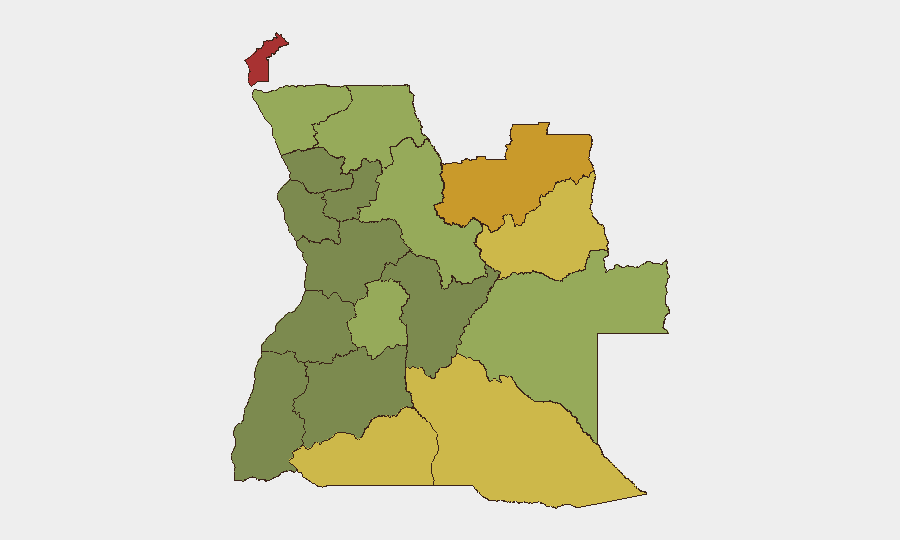
Situation Summary
Angola remains a stable mid-tier risk environment (global rank #48) with no major security incidents recorded in the past week. The threat landscape is defined by persistent crime in urban centers, ongoing landmine contamination in the southeast, and localized instability in resource-extraction zones. Current trajectory shows manageable but chronic risks requiring standard duty-of-care protocols rather than emergency response.
Key Developments
- Luanda — October 2, 2026: Angola's National Police seized more than 250 unregistered three-wheel motorbikes during an ongoing traffic enforcement operation targeting unauthorized passenger transport and registration violations. The operation reflects continued enforcement focus on informal transport networks in the capital.
- Luanda — October 3, 2026: The government and Justice Employees' Union reached an agreement to suspend a planned two-week strike by justice-sector workers; normal court and administrative operations resumed on October 5. The resolution avoided potential delays in legal proceedings and administrative services.
- Angola nationwide — October 1, 2026: Standing travel-caution advisories remained in effect, citing crime, health risks, unrest, and landmine contamination as persistent hazards requiring heightened awareness across the country.
Highest-Risk Areas
The eastern and northeastern provinces—Cabinda (78), Lunda Norte (72), and Lunda Sul (68)—drive Angola's sub-national risk profile, driven by diamond-mining competition, historically weak state capacity, and cross-border trafficking routes. Cabinda's oil-production infrastructure and secessionist-linked tensions compound risk. Southeastern provinces (Cuando Cubango, 64; Cunene, 62) face landmine density, informal border activity, and economic marginalization. Central provinces (Huambo, 50; Moxico, 58) remain secondary concerns. Low-risk provinces (Bié, Huíla) reflect stronger state presence and lower crime prevalence but retain baseline hazards common to Angola's informal economy.
How GeoBit Would Assist
Security and risk teams operating in Angola should leverage Intel Sweep and multi-language OSINT to monitor Cabinda and Lunda provinces for trafficking, labor disputes, and supply-chain disruption signals. AOI Monitoring & Early Warning on high-risk provinces and logistics nodes (ports, refineries, mining sites) enables persistent watch for crime escalation, labor unrest, or cross-border incursion without continuous manual review. Routing & Network Analysis supports journey planning for personnel and assets, incorporating landmine-risk data, crime hotspots, and checkpoint locations to optimize safety and operational continuity.
7-Day Outlook
No imminent security escalation is anticipated. Justice-sector normalization should ease administrative friction for businesses and expatriate communities. Standard vigilance toward crime in Luanda and eastern provinces remains the baseline posture; seasonal factors (Q4 economic activity, holiday travel) may increase urban crime pressure moderately in coming weeks.
Highest-Risk Areas — Ranked
| # | State / Region | Risk |
|---|---|---|
| 1 | Cabinda Province | 78 |
| 2 | Lunda Norte Province | 72 |
| 3 | Lunda Sul Province | 68 |
| 4 | Cuando Cubango Province | 64 |
| 5 | Cunene Province | 62 |
| 6 | Moxico Province | 58 |
| 7 | Zaire Province | 54 |
| 8 | Huambo Province | 50 |
| 9 | Uíge Province | 48 |
| 10 | Malanje Province | 42 |
| 11 | Bié Province | 35 |
| 12 | Huíla Province | 32 |
Sources
Previous Weekly Briefs
A new Angola brief is written every Monday, covering the week — each with its own risk map and downloadable CSV. Use the calendar to go further back.
- September 29, 2026
- September 22, 2026
- September 15, 2026
- September 8, 2026
- September 2, 2026
- August 31, 2026
- August 29, 2026
📅 Browse past briefs by calendar →
Highlighted days have a brief. Tap a day for that day's map & analysis, or “csv” for that day's dataset ($5).
Atlas — our AI intelligence desk — emails them this snapshot personally. Nothing else, no list.