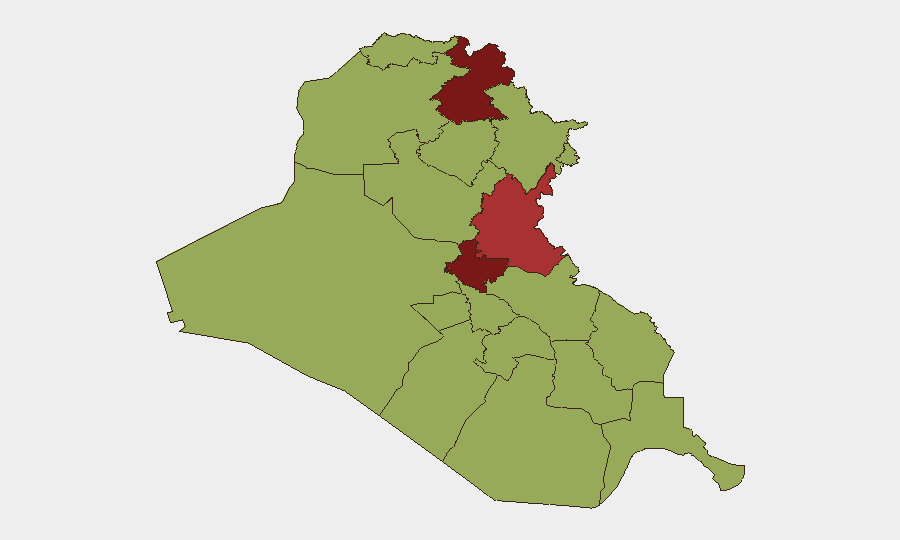
Situation Summary
Iraq remains at composite threat level 15 globally (score 74), with security conditions driven primarily by U.S.–Saudi military operations against Iran-aligned militias and subsequent escalation cycles. The most significant recent activity—joint U.S.–Saudi airstrikes on July 28–29 targeting Popular Mobilisation Forces (PMF) logistics and weapons sites across eastern Iraq—has elevated tensions in Baghdad and heightened concern over retaliatory action. Current open-source reporting for August 1–2 remains sparse; available intelligence clusters around late July events and their downstream political and operational impacts.
Key Developments
- Eastern Iraq (multi-province) – July 28–29, 2026: U.S. Central Command and Saudi forces conducted precision airstrikes on Iran-aligned militia logistics and weapons facilities across Baghdad, Wasit, Nineveh, Basra, Kirkuk, Karbala, and Diyala. PMF reported at least 20 fighters killed and 32 wounded.
- Baghdad – July 29, 2026: Iraqi presidency and military officials publicly condemned the strikes as violations of sovereignty and reported emergency consultations to address the impact and coordinate response to potential further Iranian or militia actions.
- Eastern Iraq – July 28–29, 2026: Iraqi security forces reported operational disruption; military representatives stated the U.S.–Saudi strikes hindered ongoing internal investigations into prior attacks on PMF facilities and complicated civil–military coordination.
- Regional energy infrastructure – Late July 2026: CENTCOM disclosed that the airstrikes responded to more than 30 IRGC-directed drone attacks over 72 hours by Iraq-based groups targeting Saudi energy assets, substantially elevating cross-border attack risk.
- Baghdad – Ongoing: Heightened security posture and political tension reported; Iraqi leadership convened urgent consultations over broader Iran–U.S.–Saudi confrontation and potential retaliatory militia activity in the capital.
Note: Open-source reporting for the immediate 24–48-hour window (August 1–2) remains fragmented and lacks multi-source confirmation of incident detail. Intelligence gaps are consistent with regional reporting constraints during this period.
Highest-Risk Areas
Erbil, Baghdad, and Diyala governorates drive the national composite risk score (81.4, 80.2, and 77.7 respectively), reflecting concentration of Iran-aligned militia infrastructure, PMF presence, diplomatic and energy assets, and U.S. military engagement activity. Kirkuk (55.2) and secondary southern governorates (Babil, Wasit, Basra, Al-Anbar) remain elevated primarily due to militia presence and cross-border logistics networks. The July 28–29 strikes and ongoing threat-of-retaliation cycle sustain acute risk in Baghdad (political and diplomatic targeting) and eastern provinces (continued militia operations and potential counter-strikes).
How GeoBit Would Assist
Security teams should deploy Area-of-Interest (AOI) Monitoring & Early Warning on Erbil, Baghdad, and Diyala to track militia repositioning, force movement, and retaliatory indicators in real-time. Network & Actor Analysis and entity extraction across multi-language OSINT feeds (X, Telegram, Iraqi and Iranian sources) would isolate PMF communications, IRGC coordination signals, and government statements to detect escalation or de-escalation intent. Battle mapping and force-structure tracking would enable duty-of-care teams to identify safe corridors and assess proximity of personnel or assets to active militia concentrations.
7-Day Outlook
The cycle of drone attacks → airstrikes → political backlash → retaliation threat is likely to persist through August 2–9, with elevated risk of secondary militia responses against U.S. or Saudi-linked targets in Baghdad or eastern Iraq. Iraqi government pressure to reassert sovereignty and limit foreign military operations may reduce future cooperative strikes but will not eliminate underlying Iran–U.S. tensions. Travel and movement risk remains acute for personnel in Erbil, Baghdad, and Diyala; regional energy infrastructure remains a credible target.
Highest-Risk Areas — Ranked
| # | State / Region | Risk |
|---|---|---|
| 1 | Erbil Governorate | 81.4 |
| 2 | Baghdad Governorate | 80.2 |
| 3 | Diyala Governorate | 77.7 |
| 4 | Kirkuk Governorate | 55.2 |
| 5 | Babil Governorate | 51.4 |
| 6 | Wasit Governorate | 51.4 |
| 7 | Al-Qadisiyah Governorate | 51.4 |
| 8 | Dhi Qar Governorate | 51.4 |
| 9 | Al-Muthanna Governorate | 51.4 |
| 10 | Maysan Governorate | 51.4 |
| 11 | Al-Basra Governorate | 51.4 |
| 12 | Al-Anbar Governorate | 51.4 |
Sources
Previous Daily Briefs
A new Iraq brief is written every day — each with its own risk map and downloadable CSV. Here's the last week; use the calendar to go further back.
📅 Browse every day by calendar →
Highlighted days have a brief. Tap a day for that day's map & analysis, or “csv” for that day's dataset ($5).
Atlas — our AI intelligence desk — emails them this snapshot personally. Nothing else, no list.