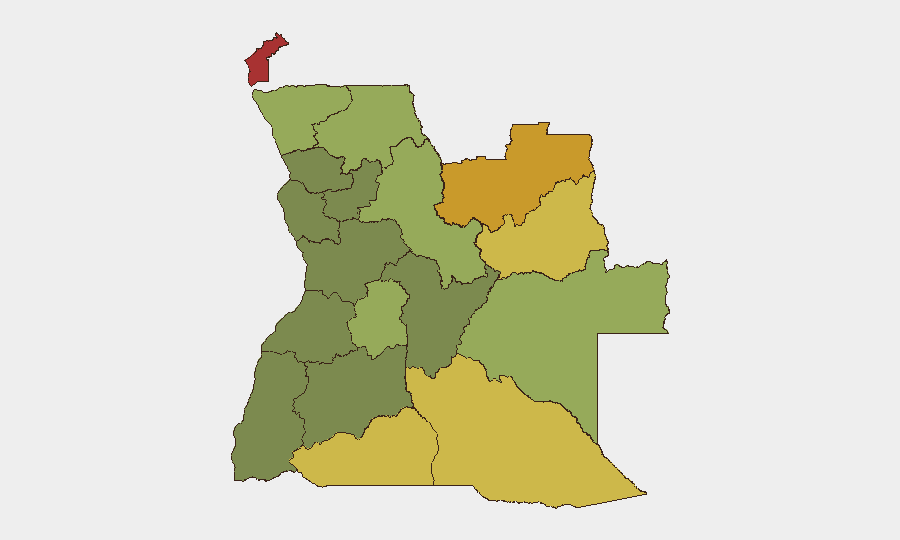
Situation Summary
Angola remains a moderate-risk environment (global rank #48, composite score 40) with no tracked security incidents in the past week. Crime and unexploded ordnance (UXO) remain the primary threats to corporate operations and personnel, concentrated heavily in the eastern and northeastern provinces. The security posture is stable but fragmented by geography; risk is heavily weighted toward resource-extraction regions and border areas.
Key Developments
- Samba, Luanda — 8 October: Police arrested eight suspects in connection with a series of armed residential robberies across the capital. Officers recovered two loaded pistols, cash, bank cards, identity documents, and other stolen property, indicating organized property crime activity in urban Luanda.
- Kikolo Market, Luanda — 8 October: A fire destroyed a significant portion of Kikolo Market in central Luanda. Firefighters contained the incident; cause and full extent of damage remain unclear from available reporting.
- Angola-wide — 9 October: Angola's SIC (criminal-investigation service) reported 29,000+ crimes nationwide from January through September 2026, including 9,586 offenses in Luanda Province alone, with 22,000+ arrests. The assessment underscores persistent property crime, robbery, and minor assault as dominant crime categories.
- Luanda — 11 October: A planned strike by TAAG (Angolan national airline) maintenance technicians began, scheduled for 11–15 October. The airline activated an operational-continuity plan; potential flight disruptions and schedule delays are expected for corporate and personnel movements during this window.
Highest-Risk Areas
Cabinda Province (risk 78), Lunda Norte (72), and Lunda Sul (68) drive Angola's sub-national threat profile, driven by a combination of UXO contamination from historical conflict, artisanal and illegal mining activity, weak state presence, and proximity to the Democratic Republic of the Congo border. These three provinces account for the majority of Angola's extractive-industry workforce and are critical to oil and diamond operations. Cuando Cubango and Cunene provinces in the south present elevated risk from border instability and criminal networks. The capital, Luanda, and surrounding Luanda Province register lower but meaningful risk from organized property crime, armed robbery, and gang activity affecting urban commercial and residential areas.
How GeoBit Would Assist
Security and risk teams operating in Angola would employ AOI Monitoring & Early Warning to track developments in high-risk provinces (Cabinda, Lunda Norte/Sul, border regions) with persistent alerting for violence, UXO incidents, and mining-related conflict. OSINT fusion and multi-language search capabilities enable real-time synthesis of Portuguese-language and regional reporting to close gaps in English-language media. Routing & Network Analysis supports alternative journey and evacuation planning for personnel in resource-extraction zones, mitigating exposure to UXO and regional instability.
7-Day Outlook
The immediate outlook remains stable. The TAAG technician strike (11–15 October) poses a near-term operational constraint on aviation; personnel and cargo movements should be confirmed in advance. Urban crime in Luanda is expected to remain at baseline levels. Attention should remain on the eastern provinces, where UXO hazards and artisanal mining friction persist; no escalation is indicated but the risk environment is structurally unchanged.
Highest-Risk Areas — Ranked
| # | State / Region | Risk |
|---|---|---|
| 1 | Cabinda Province | 78 |
| 2 | Lunda Norte Province | 72 |
| 3 | Lunda Sul Province | 68 |
| 4 | Cuando Cubango Province | 64 |
| 5 | Cunene Province | 62 |
| 6 | Moxico Province | 58 |
| 7 | Zaire Province | 54 |
| 8 | Huambo Province | 50 |
| 9 | Uíge Province | 48 |
| 10 | Malanje Province | 42 |
| 11 | Bié Province | 35 |
| 12 | Huíla Province | 32 |
Sources
Previous Weekly Briefs
A new Angola brief is written every Monday, covering the week — each with its own risk map and downloadable CSV. Use the calendar to go further back.
- October 6, 2026
- September 29, 2026
- September 22, 2026
- September 15, 2026
- September 8, 2026
- September 2, 2026
- August 31, 2026
📅 Browse past briefs by calendar →
Highlighted days have a brief. Tap a day for that day's map & analysis, or “csv” for that day's dataset ($5).
Atlas — our AI intelligence desk — emails them this snapshot personally. Nothing else, no list.