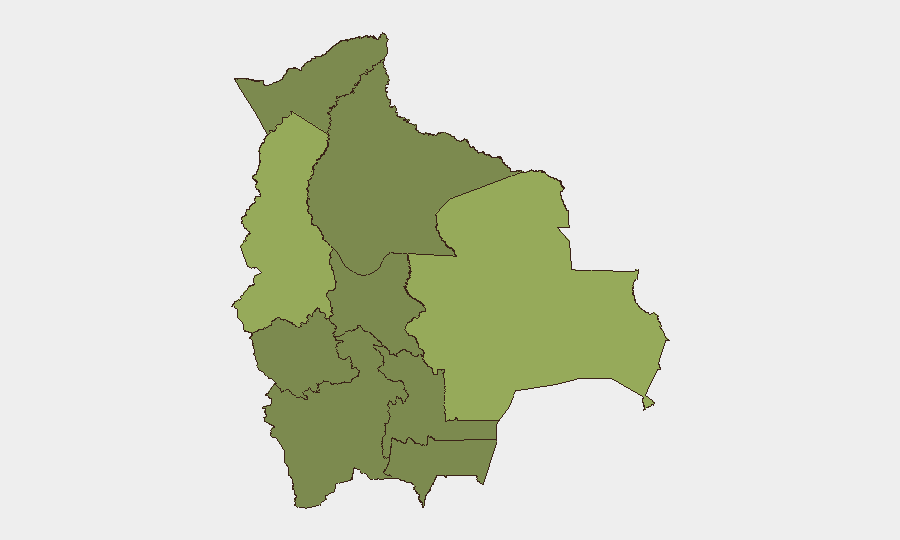
Situation Summary
Bolivia remains in a heightened state of instability marked by concurrent criminal violence, labor unrest, and institutional tensions. La Paz and Santa Cruz—the political and economic centers—are experiencing the most acute pressure, with recent killings, detentions, and public statements from senior military and civilian leadership indicating fragmentation in the state's ability to maintain order. The composite threat score of 34 places Bolivia at #51 globally, but sub-national concentration in La Paz (53.5) and Santa Cruz (46) reflects acute localized risk rather than diffuse national threat.
Key Developments
- La Paz, 31 July–2 August: Escalating public statements from the President and Colonel-rank military figures, paired with citizen disapproval of organized crime activity, suggest internal disagreement over crime response strategy and possible institutional friction between civilian and military branches.
- Santa Cruz / Regional, 1 August: Criminal actors deployed conventional military-grade force in at least one incident; simultaneous police public statement and Colonel's condemnation of criminal activity indicate law enforcement is engaged but facing organized, well-equipped opposition.
- Police-Settler Incident, 1 August: Assassination of a settler by police in an unspecified location signals potential escalation in land-tenure or resource disputes, or possible mistaken-identity/excessive-force incident.
- Prison System, 31 July–1 August: Detentions and arrests linked to prison administration and state control suggest overcrowding, gang activity, or breakdown in custodial oversight.
- International Signal, 1 August: Public statement attributed to New York (likely diplomatic or UN body) regarding Bolivia indicates international concern is rising and may foreshadow diplomatic or humanitarian pressure.
Highest-Risk Areas
La Paz and Santa Cruz together account for nearly 60% of sub-national risk concentration. La Paz's elevated score (53.5) reflects political fragility, institutional tensions between civilian and military leadership, and dense urban crime networks; Santa Cruz (46) combines organized criminal activity with resource conflicts and proximity to trafficking routes. The remaining departments cluster at substantially lower risk (23–37), indicating that security threats and duty-of-care exposure are heavily geographically concentrated. Organizations with personnel or operations in the capital and commercial hub should treat these zones as distinct operational security environments requiring separate protocols.
How GeoBit Would Assist
GeoBit's Intel Sweep and global event feeds with multi-language OSINT would provide real-time tracking of officer statements, military announcements, and criminal-group activity across Bolivia's fragmented political scene. AOI Monitoring & Early Warning set on La Paz and Santa Cruz would deliver persistent alerting on protest escalation, resource disputes, and violence clusters before they reach crisis threshold. Network & Actor Analysis would map relationships between military figures, police leadership, and organized-crime nodes, enabling security teams to anticipate institutional fractures and identify safe passage corridors and secure zones.
7-Day Outlook
Over the next week, expect continued public friction between civilian and military leadership, with crime violence likely persisting in Santa Cruz and reaching into peripheral departments. International diplomatic attention may increase, potentially triggering temporary security operations that disrupt commerce and movement. Organizations should assume La Paz and Santa Cruz remain high-risk for at least 7–10 days pending clarification of institutional alignments.
Highest-Risk Areas — Ranked
| # | State / Region | Risk |
|---|---|---|
| 1 | La Paz | 53.5 |
| 2 | Santa Cruz | 46 |
| 3 | Beni | 37 |
| 4 | Potosí | 23.4 |
| 5 | Tarija | 23.4 |
| 6 | Pando | 23.4 |
| 7 | Oruro | 23.4 |
| 8 | Cochabamba | 23.4 |
| 9 | Chuquisaca | 23.4 |
Sources
Previous Daily Briefs
A new Bolivia brief is written every day — each with its own risk map and downloadable CSV. Here's the last week; use the calendar to go further back.
📅 Browse every day by calendar →
Highlighted days have a brief. Tap a day for that day's map & analysis, or “csv” for that day's dataset ($5).
Atlas — our AI intelligence desk — emails them this snapshot personally. Nothing else, no list.