Situation Summary
Angola remains a moderate-risk environment (#49 globally; composite threat score 40) with security pressures concentrated in resource-rich border provinces. The past week has seen continued illicit cross-border activity, routine law-enforcement operations, and regional transport disruptions affecting commerce. No major incidents or escalations were recorded, though structural vulnerabilities in border control, road safety, and informal-economy enforcement persist.
Key Developments
- Lunda Norte Province, 13–20 October: Angolan police recorded 153 border-crossing violations involving 781 Democratic Republic of Congo nationals across multiple frontier posts, including Camaxilo municipality. Violations typically involve undocumented entry, smuggling, and informal labor migration.
- Lunda Norte & Lunda Sul Provinces, 23 October: Authorities seized 120 diamonds, 220 kg of narcotics, and 2,925 liters of contraband fuel linked to illicit mining and smuggling networks. Confiscations included mining equipment in Cafunfo and surrounding areas, indicating organized extraction and trafficking operations remain active.
- Cuanza Sul Province, 27 October: A crash on the EN-100 highway killed seven people, consistent with the province's persistently high road-fatality rate and reflecting infrastructure and vehicle safety risks for travelers.
- Angola–DRC Border Region, 30 October: Protests in the Democratic Republic of Congo reportedly stranded and damaged Angolan freight trucks, creating immediate cross-border logistics disruption and signaling vulnerability of land-transport corridors to regional instability.
- Angola Nationwide, 27 October: Candidates for admission to the magistracy alleged irregularities in recruitment examinations, including inconsistent rules, mobile-phone use, and attempted corruption. This reflects governance-integrity concerns with potential downstream effects on rule-of-law credibility.
- Angola Nationwide, 27 October: The government proposed a 10% public-sector salary increase for 2027, which unions rejected as insufficient against earlier wage commitments. Labor friction may affect civil-service availability and morale, including border and law-enforcement personnel.
- Angola–Tanzania Regional Infrastructure, 29 October: Angola and Tanzania agreed in principle to connect the Lobito/Benguela corridor through Zambia and the DRC to Dar es Salaam. While construction occurs outside Angola, corridor development may increase transit traffic and associated border-management demands.
Highest-Risk Areas
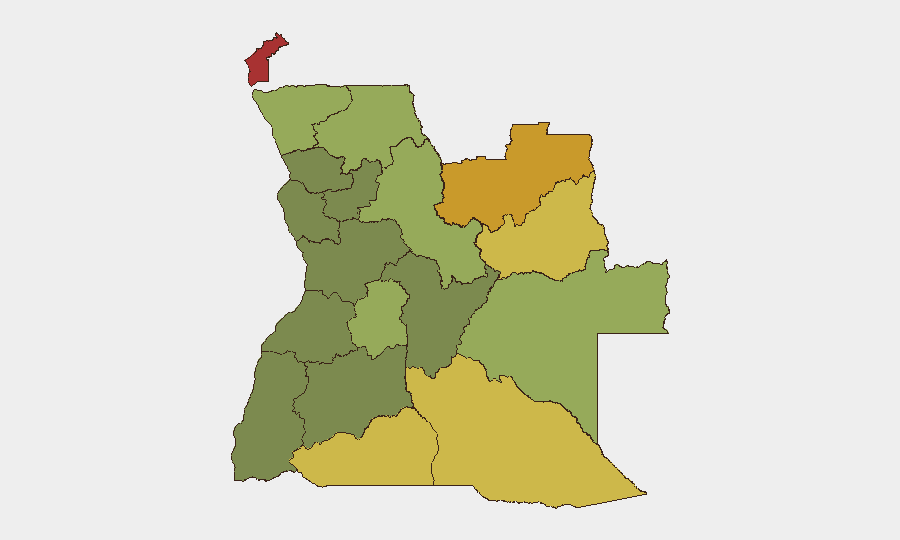
Cabinda Province (risk 78) and the Lunda Norte/Sul complex (72 and 68, respectively) drive Angola's sub-national threat profile, driven by illicit-diamond extraction, narcotics trafficking, and porous DRC border control. Cuando Cubango, Cunene, and Moxico provinces (64, 62, 58) form a secondary risk band along the southern and eastern borders, where informal cross-border movement and resource smuggling remain endemic. Oil and mining assets, expatriate workers, and supply chains in these zones face elevated exposure to criminal networks and governance gaps.
How GeoBit Would Assist
Security teams should deploy AOI Monitoring & Early Warning focused on Cabinda and Lunda provinces to track smuggling operations, trafficking routes, and informal-border crossings in near-real time. Intelligence & OSINT (multi-language feeds, Telegram/social monitoring, entity extraction) provides pattern detection of criminal-network communications and trafficking signaling. Routing & Network Analysis enables alternative-route planning for personnel and cargo to avoid disrupted DRC corridors and high-risk provinces, while GIS & Spatial Analysis supports risk-layering by location and asset type.
7-Day Outlook
No major escalation is forecast in the immediate term. Illicit cross-border activity will likely persist at current levels, with law-enforcement sweeps continuing episodically. Regional transport risks (DRC protests, road safety) remain acute; personnel and logistics planning should account for corridor delays and security gaps in Lunda and Cuanza provinces.
Highest-Risk Areas — Ranked
| # | State / Region | Risk |
|---|---|---|
| 1 | Cabinda Province | 78 |
| 2 | Lunda Norte Province | 72 |
| 3 | Lunda Sul Province | 68 |
| 4 | Cuando Cubango Province | 64 |
| 5 | Cunene Province | 62 |
| 6 | Moxico Province | 58 |
| 7 | Zaire Province | 54 |
| 8 | Huambo Province | 50 |
| 9 | Uíge Province | 48 |
| 10 | Malanje Province | 42 |
| 11 | Bié Province | 35 |
| 12 | Huíla Province | 32 |
Sources
Previous Weekly Briefs
A new Angola brief is written every Monday, covering the week — each with its own risk map and downloadable CSV. Use the calendar to go further back.
- October 27, 2026
- October 20, 2026
- October 13, 2026
- October 6, 2026
- September 29, 2026
- September 22, 2026
- September 15, 2026
📅 Browse past briefs by calendar →
Highlighted days have a brief. Tap a day for that day's map & analysis, or “csv” for that day's dataset ($5).
Atlas — our AI intelligence desk — emails them this snapshot personally. Nothing else, no list.