Situation Summary
Bolivia faces elevated near-term security risk driven by a sharp spike in organized violent crime concentrated in Santa Cruz and Cochabamba departments. At least seven deaths have occurred across four separate incidents in the past 48 hours—primarily firearm homicides and executions—with strong indicators of transnational criminal involvement along the Brazil border. Presidential and institutional responses are in early stages; police deployments have increased, but the velocity and coordination of these attacks suggest organized capacity rather than isolated criminality.
Key Developments
- San Matías, Santa Cruz – Ascensión de la Frontera (July 31, ~13:00): Four gunmen on two motorcycles conducted an armed ambush on a pickup truck, killing subteniente Yerson Salazar Aliendres and one civilian using high-caliber weapons. Body recovered after 48-hour search operation (Aug 2).
- San Matías, Santa Cruz – Campo Nuevo estancia (July 30–31): Armed attackers in a vehicle opened fire on occupants of a rural property, resulting in four fatalities in a single incident less than 24 hours before the Ascensión attack.
- Yapacaní, Santa Cruz (July 31 morning): Two decapitated male bodies discovered in rural zone near Puerto Gretel; classified as homicides and linked by police intelligence to the broader crime cluster.
- Cocapata route, Cochabamba – Falsuri community (July 31–Aug 1): One male found dead in homicide circumstances; two suspects apprehended by local residents and transferred to authorities.
- Multi-departmental surge (July 30–31): Bolivian national media and police intelligence units confirm a coordinated "ola de crímenes violentos" (wave of violent crimes) spanning Santa Cruz and Cochabamba, with at least seven deaths in separate but temporally clustered incidents.
- Border security response (Aug 1–3): Local and national police increased operational tempo and intelligence deployments in San Matías and along the Brazil frontier, indicating official concern over cross-border trafficking and transnational criminal nexus.
- Institutional posture (Aug 2–3): Presidential and police public statements issued; formal investigations underway into organized-crime links and possible cartel involvement in the shootings.
Highest-Risk Areas
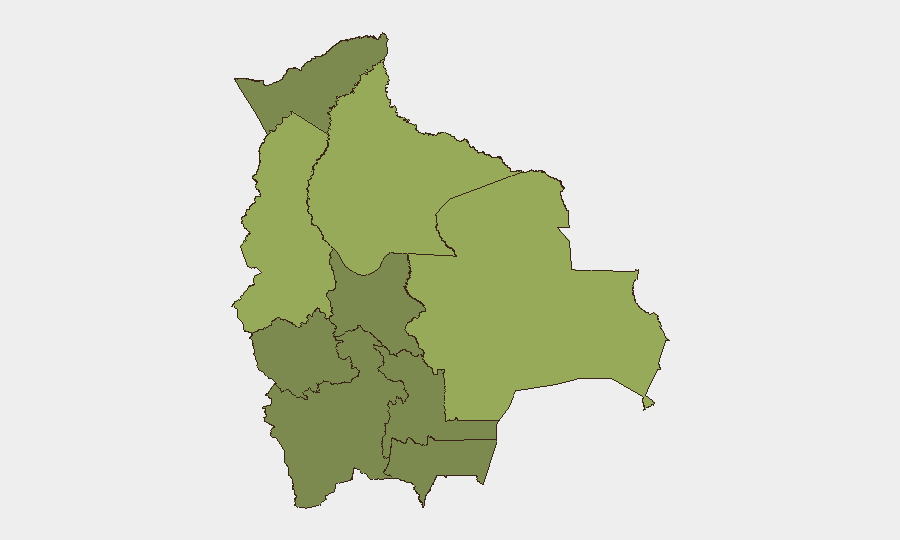
Beni (52.8), Santa Cruz (49.6), and La Paz (48.0) comprise Bolivia's three highest-risk departments. Santa Cruz and Cochabamba are currently the acute focus: the past 48 hours of violence—concentrated in San Matías (border municipality), Yapacaní, and Cocapata—underscore Santa Cruz's vulnerability to transnational organized crime, particularly along the Brazilian frontier where trafficking networks and cross-border criminal groups operate with minimal interception. Beni's ranking reflects chronic instability; La Paz combines political volatility with urban crime. The remaining seven departments show markedly lower risk (all 22.8), indicating that threat is heavily concentrated in three states.
How GeoBit Would Assist
Security teams with personnel or assets in Bolivia should prioritize AOI Monitoring & Early Warning on San Matías, Yapacaní, and surrounding Santa Cruz municipalities to detect emerging patterns in violent-crime clusters and armed-group movement. Network & Actor Analysis and OSINT fusion (X/Telegram, local news feeds, radio SIGINT) will corroborate reporting on criminal-organization involvement and cross-border trafficking logistics. Routing & Network Analysis enables alternative journey planning for staff in high-risk departments, particularly along routes near the Brazil border and within Santa Cruz and Cochabamba.
7-Day Outlook
The spike in coordinated, lethal violence over 48 hours suggests organized criminal capability rather than spontaneous crime; absent rapid police success in detaining perpetrators, further incidents in Santa Cruz and Cochabamba are probable within 7 days. Institutional response intensity will likely increase, but enforcement capacity in remote/border zones remains constrained. Risk for corporate or expatriate personnel in these departments should be reassessed with security teams immediately.
Highest-Risk Areas — Ranked
| # | State / Region | Risk |
|---|---|---|
| 1 | Beni | 52.8 |
| 2 | Santa Cruz | 49.6 |
| 3 | La Paz | 48 |
| 4 | Potosí | 22.8 |
| 5 | Tarija | 22.8 |
| 6 | Pando | 22.8 |
| 7 | Oruro | 22.8 |
| 8 | Cochabamba | 22.8 |
| 9 | Chuquisaca | 22.8 |
Sources
Previous Daily Briefs
A new Bolivia brief is written every day — each with its own risk map and downloadable CSV. Here's the last week; use the calendar to go further back.
📅 Browse every day by calendar →
Highlighted days have a brief. Tap a day for that day's map & analysis, or “csv” for that day's dataset ($5).
Atlas — our AI intelligence desk — emails them this snapshot personally. Nothing else, no list.