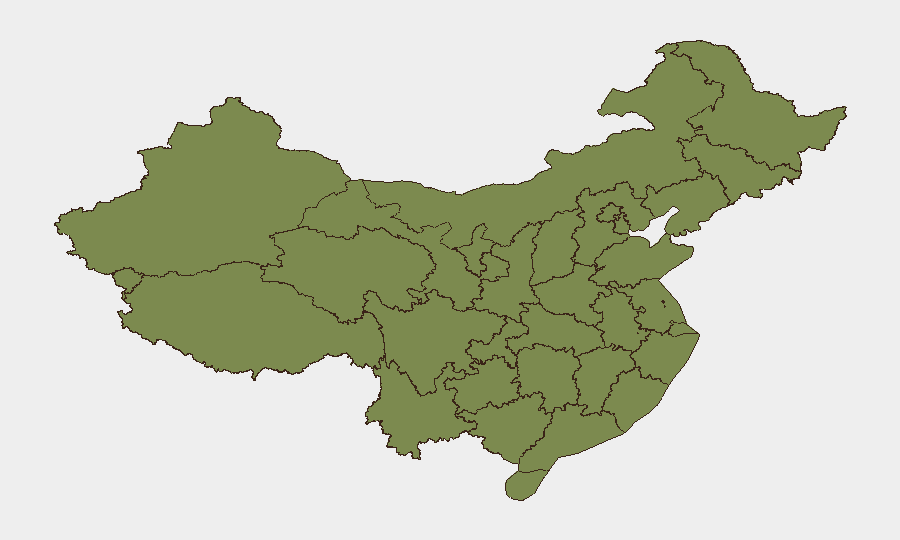
Situation Summary
China's composite threat score of 8 places it at rank #102 globally, reflecting a stable but fragmented security environment. Open-source coverage over the last 24–48 hours documents no major civil unrest, terrorism, or infrastructure collapse; however, a significant industrial incident in Fujian province and recent military/diplomatic signals warrant close monitoring. The concentration of detected risk in Beijing (32.5) and Guangdong (10.9) reflects both operational activity and population density, while most other provinces remain at low absolute risk levels.
Key Developments
- Jinjiang, Fujian – 30 July 2026 – Industrial fire at shoe factory: A deadly factory fire caused multiple casualties and prompted presidential-level search-and-rescue mobilization. Exact death toll not yet publicly confirmed; emergency medical operations ongoing. This is the only acute incident clearly time-stamped to the last 48 hours in open-source reporting.
- National level – 28 July 2026 – Military mobilization signal: Event feeds recorded a "Military Mobilization" event attributed to the Ministry on 28 July. Context from earlier-week coverage (outside this window) references submarine missile testing and China–Russia naval drills, but specific operational details remain limited in open sources.
- National level – 28 July 2026 – Presidential disapproval statement: A "Disapprove" signal involving the President was recorded, likely related to domestic or international policy; precise subject matter not specified in available open-source corroboration.
- National level – 28 July 2026 – Enforcement action (Arrest/Detain): China-attributed arrest or detention event recorded but not detailed in corroborated open-source reporting.
- National level – 28 July 2026 – Diplomatic friction: Public statements exchanged between UNESCO and China, and between Congress and China, suggesting ongoing diplomatic friction on unspecified topics (cultural heritage, human rights, trade, or other international issues).
- Beijing (implied) – 28 July 2026 – Multi-actor tensions: Signals include disapproval between companies and China, a public statement from China regarding a village, and a tourist-related disapproval event, collectively suggesting localized grievances or enforcement actions.
Highest-Risk Areas
Beijing dominates the sub-national ranking at 32.5—a three-fold increase over the next-highest region (Guangdong, 10.9)—reflecting both capital-city concentration of political, diplomatic, and security activity, and a larger absolute volume of tracked events. Guangdong and Hubei follow at 10.9 and 8.9 respectively, likely driven by economic activity, maritime exposure, and historical protest or labor-dispute frequency. Shanghai (7.0) and Sichuan (5.4) round out elevated-risk zones. The remaining eight ranked provinces all score below 3.6, indicating that acute risk is heavily concentrated in economic and administrative hubs rather than distributed across China.
How GeoBit Would Assist
Security teams monitoring China should deploy AOI (Area-of-Interest) Monitoring & Early Warning on Beijing, Guangdong, and Fujian to capture emerging incidents in real time, coupled with Intel Sweep and multi-language OSINT fusion to corroborate open-source signals and fill gaps left by limited official disclosure. Conflict, terrorism, and crime search capabilities combined with Network & Actor Analysis enable rapid contextualization of enforcement actions and civil tensions, while satellite and imagery analysis of industrial zones and infrastructure can support early detection of asset risk (as exemplified by the Fujian factory fire). Routing & Network Analysis assists in contingency planning for personnel in high-risk provinces.
7-Day Outlook
No imminent large-scale security deterioration is signaled in open sources; however, the Fujian industrial incident and recent military mobilization signals suggest continued operational tempo. Corporate security teams should maintain heightened monitoring of Beijing and Guangdong over the coming week and prepare contingency protocols for supply-chain disruption in Fujian pending final incident assessment.
Highest-Risk Areas — Ranked
| # | State / Region | Risk |
|---|---|---|
| 1 | Beijing | 32.5 |
| 2 | Guangdong Province | 10.9 |
| 3 | Hubei | 8.9 |
| 4 | Shanghai | 7 |
| 5 | Sichuan | 5.4 |
| 6 | Tibet | 4.5 |
| 7 | Jiangsu | 3.6 |
| 8 | Fujian | 3.4 |
| 9 | Jiangxi | 3.2 |
| 10 | Henan | 3.1 |
| 11 | Zhejiang | 3.1 |
| 12 | Gansu | 2.9 |
Sources
Previous Daily Briefs
A new China brief is written every day — each with its own risk map and downloadable CSV. Here's the last week; use the calendar to go further back.
📅 Browse every day by calendar →
Highlighted days have a brief. Tap a day for that day's map & analysis, or “csv” for that day's dataset ($5).
Atlas — our AI intelligence desk — emails them this snapshot personally. Nothing else, no list.