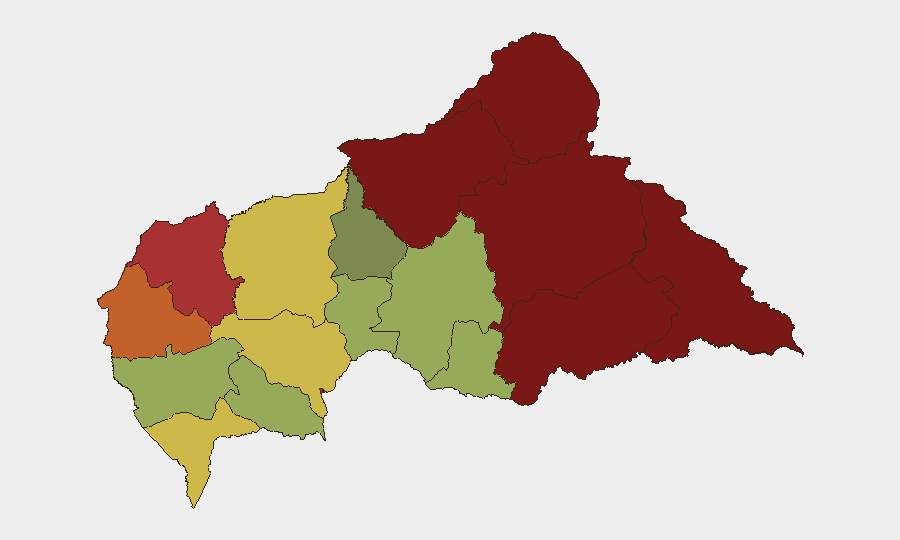
Situation Summary
Central African Republic remains in a protracted state of fragility driven by ongoing armed group activity, particularly the UPC and other non-state actors operating across the northern and eastern prefectures. Recent security operations (early August) have yielded weapon seizures and militant casualties, suggesting active counter-insurgency pressure; however, the underlying conflict drivers—territorial control, resource competition, and cross-border spillover—remain unresolved. The country's composite threat ranking (#33 globally, score 65) reflects persistent war-level risk concentrated in specific geographic zones rather than nationwide instability. Current trajectory shows tactical security gains offset by structural vulnerability to resumption of large-scale violence.
Key Developments
- Bangui, 14 August — President Touadéra marked CAR's 66th Independence Day with military and civilian parades, using the platform to call for institutional reforms and anti-corruption measures; no security incidents reported during ceremonies.
- No verified security incidents reported in the past 48 hours (15–17 August 2026). Web research and monitored feeds did not surface confirmed attacks, armed clashes, or major crime events in this window.
- Institutional disruption note, 11 August — Major internet connectivity disruption reported across CAR; cause and duration remain unconfirmed. Relevant to corporate communications and supply-chain coordination.
- Diplomatic context, 11–12 August — France initiated disciplinary proceedings and administrative inquiry against its ambassador to CAR over alleged misconduct; does not directly affect general security posture but reflects diplomatic tensions within the international presence.
- Background: Ongoing disarmament (8 August) — 69 UPC militants voluntarily surrendered weapons as part of ongoing disarmament program; indicates some willingness to engage with state-led processes, though scale and sustainability remain limited.
Highest-Risk Areas
Vakaga (risk 95), Bamingui-Bangoran (92), and Haute-Kotto (88) in the north and east dominate the sub-national risk profile and account for the country's elevated composite score. These prefectures are strongholds of armed group presence, particularly the UPC, and experience the highest frequency of violent clashes, weapons trafficking, and civilian displacement. Bangui (78) and Ombella-M'Poko (62), which include or border the capital, face elevated risk from urban crime, political instability, and sporadic militant incursions, but remain relatively more stable than frontier zones. Risk drops significantly in central and southern prefectures (Kémo 58, Ouham 65), though all regions remain vulnerable to rapid escalation given weak state capacity and permeable borders.
How GeoBit Would Assist
Security and duty-of-care teams operating in or supporting CAR should utilize AOI Monitoring & Early Warning with persistent watch on Vakaga, Bamingui-Bangoran, and Haute-Kotto to detect militant movement, weapons caches, or violence upticks before they affect personnel or operations. Network & Actor Analysis and OSINT fusion capabilities enable tracking of UPC leadership, foreign militant presence (including reported Russian specialists), and cross-border recruitment or supply lines. Conflict & Military battle mapping and force-structure tracking provide situational awareness of state security operations and armed group repositioning, informing route planning and security posture adjustments.
7-Day Outlook
No imminent nationwide escalation is indicated; however, the northern frontier regions remain volatile and prone to tactical clashes during disarmament and counter-insurgency operations. Independence Day observances concluded without incident, reducing short-term ceremonial risk. Organizations should maintain heightened alertness in Vakaga, Bamingui-Bangoran, and transit corridors to northern prefectures, and monitor for any disruptions to internet and communications services that may impede situational awareness or coordination.
Highest-Risk Areas — Ranked
| # | State / Region | Risk |
|---|---|---|
| 1 | Vakaga | 95 |
| 2 | Bamingui-Bangoran | 92 |
| 3 | Haute-Kotto | 88 |
| 4 | Haut-Mbomou | 85 |
| 5 | Mbomou | 82 |
| 6 | Ouham-Pendé | 79 |
| 7 | Bangui | 78 |
| 8 | Nana-Mambéré | 75 |
| 9 | Sangha-Mbaéré | 68 |
| 10 | Ouham | 65 |
| 11 | Ombella-M'Poko | 62 |
| 12 | Kémo | 58 |
Sources
Previous Daily Briefs
A new Central African Republic brief is written every day — each with its own risk map and downloadable CSV. Here's the last week; use the calendar to go further back.
- August 16, 2026
- August 15, 2026
- August 14, 2026
- August 13, 2026
- August 12, 2026
- August 11, 2026
- August 10, 2026
📅 Browse every day by calendar →
Highlighted days have a brief. Tap a day for that day's map & analysis, or “csv” for that day's dataset ($5).
Atlas — our AI intelligence desk — emails them this snapshot personally. Nothing else, no list.