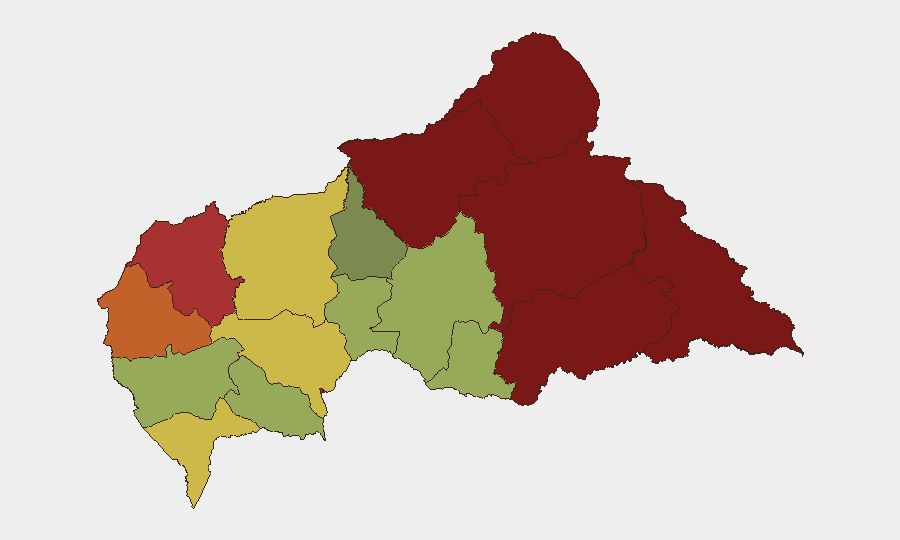
Situation Summary
Central African Republic remains under sustained pressure from multiple armed groups operating across its northern and eastern prefectures, with the 3R rebel faction demonstrating continued offensive capability against state forces. MINUSCA's peacekeeping presence faces active hostility, and administrative friction over foreign security contractors in Bangui reflects underlying fragility in the capital's governance environment. The security picture remains fluid but shows no signs of near-term stabilization; threat levels remain concentrated in peripheral regions while the capital experiences slower-burn administrative and criminal pressures.
Key Developments
- Mann, Vakaga – 5 September 2026: 3R rebel elements conducted a large-scale dawn assault on FACA positions, killing six civilians and wounding several others. MINUSCA confirmed casualties and condemned the attack as a serious violation of international humanitarian law.
- Bangui – early September 2026 (ongoing): CAR's Interior Ministry has escalated regulatory and contractual pressure on Amarante, a French private security firm providing protection to the EU delegation. The dispute reflects broader friction between national authorities and foreign security operators and may complicate diplomatic and expatriate movement protocols.
- Northern CAR – early September 2026: Presidential meetings convened through July–early September continue to address security responses to a northern armed group's late-June offensive. Russian Wagner elements and the "Africa Corps" structure remain integrated into the government's coordination framework; the northern front remains an active security concern.
- UN Peacekeeping – early September 2026 (date/location partial): At least three MINUSCA peacekeepers were injured in a hostile act; MINUSCA statements condemn the incident as part of a pattern of attacks against UN personnel, signaling elevated force-protection risk and potential collateral hazard during UN movements and operations.
Highest-Risk Areas
Vakaga, Bamingui-Bangoran, and Haute-Kotto prefectures anchor the threat landscape, with composite risk scores of 95, 92, and 88 respectively. These northeastern and north-central regions host multiple armed-group sanctuaries, including 3R elements, and serve as both operational bases and conflict zones; the Mann attack in Vakaga exemplifies this pattern. Haut-Mbomou and Mbomou (eastern corridor, scores 85 and 82) remain exposed to cross-border incursion and banditry. Bangui itself (risk 78) faces lower-intensity but persistent administrative friction, criminality, and potential civil-military tensions that can rapidly escalate; this combination makes the capital a secondary but distinct risk node for organizations with diplomatic, expatriate, or supply-chain presence.
How GeoBit Would Assist
Security teams should deploy AOI Monitoring & Early Warning on Vakaga, Bamingui-Bangoran, and Haute-Kotto to detect armed-group movement and attack indicators before they materialize. Intel Sweep and multi-language OSINT fusion across regional wire services, Telegram channels, and local Bangui media would provide early signals of administrative disputes, checkpoint incidents, or protest activity in the capital that could affect movement and staffing. Conflict & Military force-structure tracking and Network & Actor Analysis would clarify the command chain, logistics posture, and current operational tempo of 3R and competing armed groups, enabling predictive routing and force-posture planning.
7-Day Outlook
No major de-escalation is expected in the next seven days. The 3R's demonstrated offensive reach and the government's reliance on Russian military coordination suggest continued low-to-moderate kinetic activity in the north and east. Bangui's administrative tensions around foreign security may remain elevated but are unlikely to trigger immediate kinetic incidents; however, cumulative friction could create openings for opportunistic crime or civil unrest if not monitored closely.
Highest-Risk Areas — Ranked
| # | State / Region | Risk |
|---|---|---|
| 1 | Vakaga | 95 |
| 2 | Bamingui-Bangoran | 92 |
| 3 | Haute-Kotto | 88 |
| 4 | Haut-Mbomou | 85 |
| 5 | Mbomou | 82 |
| 6 | Ouham-Pendé | 79 |
| 7 | Bangui | 78 |
| 8 | Nana-Mambéré | 75 |
| 9 | Sangha-Mbaéré | 68 |
| 10 | Ouham | 65 |
| 11 | Ombella-M'Poko | 62 |
| 12 | Kémo | 58 |
Sources
Previous Weekly Briefs
A new Central African Republic brief is written every Monday, covering the week — each with its own risk map and downloadable CSV. Use the calendar to go further back.
- September 2, 2026
- September 1, 2026
- August 31, 2026
- August 30, 2026
- August 29, 2026
- August 27, 2026
- August 26, 2026
📅 Browse past briefs by calendar →
Highlighted days have a brief. Tap a day for that day's map & analysis, or “csv” for that day's dataset ($5).
Atlas — our AI intelligence desk — emails them this snapshot personally. Nothing else, no list.