Situation Summary
Central African Republic remains in a fragile security state characterized by persistent armed-group presence, criminal networks, and periodic violence in peripheral regions, particularly along borders. The African Union Peace and Security Council flagged deepening insecurity in Vakaga, Haut-Mbomou, and Mbomou prefectures as of 1 September 2026, with ongoing reports of civilian displacement and abuses by multiple armed actors including national forces and Russian contractors. Political tension has also escalated in Bangui, with government threats of legal action against opposition figures. While the precise location and timing of the reported 60 casualties announced on 12 September remain unclear in available reporting, the figure signals recent high-casualty clashes within the country.
Key Developments
- Nationwide, 1 September (reported 9 September): African Union Peace and Security Council issued a communiqué expressing deep concern over persistent insecurity in Vakaga, Haut-Mbomou, and Mbomou, citing residual armed groups, criminal networks, and recurring attacks on civilians and security forces.
- Nationwide, 8 September: UN situation report No. 84 confirmed ongoing fragile security conditions with periodic violence and displacement affecting civilian movement and humanitarian access across multiple regions.
- Zemio, Haut-Mbomou, 11 September: Reporting indicated continuing insecurity and documented abuses by armed groups, national army (FACA), and Russian Africa Corps fighters, with patterns of serious violations often occurring with impunity.
- Bangui, 9 September: Government spokesperson Évariste Ngamana issued a public warning of legal action against opposition figure Anicet Georges Dologué, signaling heightened political tension and potential judiciary pressure on opposition actors.
- Nationwide, 12 September: CAR presidency announced a death toll of 60 people killed in recent fighting; specific location and exact date of clashes not specified in available reporting, but indicates significant armed conflict activity.
- N'Djamena, Chad, 9 September (regional impact): A court in Chad sentenced former CAR rebel leader Abdoulaye Miskine to 15 years in prison on charges including murder, rape, and torture, with three co-defendants receiving 10-year sentences; potential implications for CAR rebel network dynamics and accountability perceptions, though no immediate secondary incidents in CAR reported.
Highest-Risk Areas
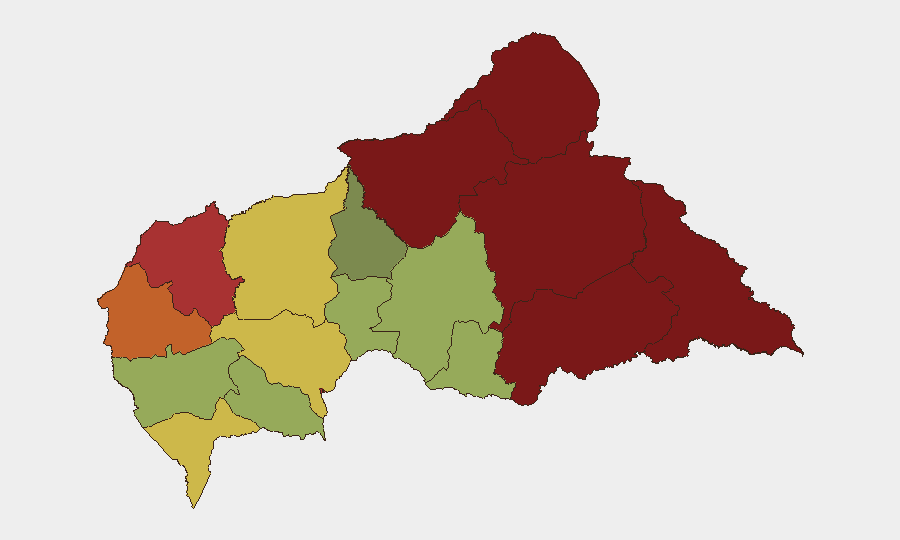
Vakaga and Bamingui-Bangoran prefectures drive the highest composite risk (95 and 92 respectively), followed by Haute-Kotto, Haut-Mbomou, and Mbomou (88, 85, and 82). The AU PSC and UN reporting specifically cite Vakaga, Haut-Mbomou, and Mbomou as epicenters of residual armed-group activity, criminal networks, and recurring attacks. Bangui itself (risk 78) presents secondary risk through political volatility and judiciary actions against opposition figures. Border regions and peripheral prefectures remain the primary security concern; travel and operations outside Bangui and secondary cities carry elevated risk of armed-group encounter, banditry, and serious civilian protection incidents.
How GeoBit Would Assist
Security teams should deploy AOI Monitoring & Early Warning on Vakaga, Haut-Mbomou, and Mbomou to track emerging incidents and armed-group movements with automated alerting. Intel Sweep and multi-language OSINT fusion would corroborate fragmented regional reporting and clarify the location and casualty details of the 12 September fighting announcement. Network & Actor Analysis applied to rebel leaders, FACA units, and Russian contractor presence would illuminate command structures and accountability risks affecting staff safety in high-risk prefectures.
7-Day Outlook
Security conditions are expected to remain volatile in border prefectures with low near-term improvement likelihood. Political pressure on opposition figures in Bangui may escalate into public confrontations or protest activity. Organizations should assume armed-group activity continues and maintain heightened situational awareness, especially for any movements tied to the Miskine sentencing or rival faction dynamics in Haut-Mbomou and Mbomou.
Highest-Risk Areas — Ranked
| # | State / Region | Risk |
|---|---|---|
| 1 | Vakaga | 95 |
| 2 | Bamingui-Bangoran | 92 |
| 3 | Haute-Kotto | 88 |
| 4 | Haut-Mbomou | 85 |
| 5 | Mbomou | 82 |
| 6 | Ouham-Pendé | 79 |
| 7 | Bangui | 78 |
| 8 | Nana-Mambéré | 75 |
| 9 | Sangha-Mbaéré | 68 |
| 10 | Ouham | 65 |
| 11 | Ombella-M'Poko | 62 |
| 12 | Kémo | 58 |
Sources
Previous Weekly Briefs
A new Central African Republic brief is written every Monday, covering the week — each with its own risk map and downloadable CSV. Use the calendar to go further back.
- September 8, 2026
- September 2, 2026
- September 1, 2026
- August 31, 2026
- August 30, 2026
- August 29, 2026
- August 27, 2026
📅 Browse past briefs by calendar →
Highlighted days have a brief. Tap a day for that day's map & analysis, or “csv” for that day's dataset ($5).
Atlas — our AI intelligence desk — emails them this snapshot personally. Nothing else, no list.