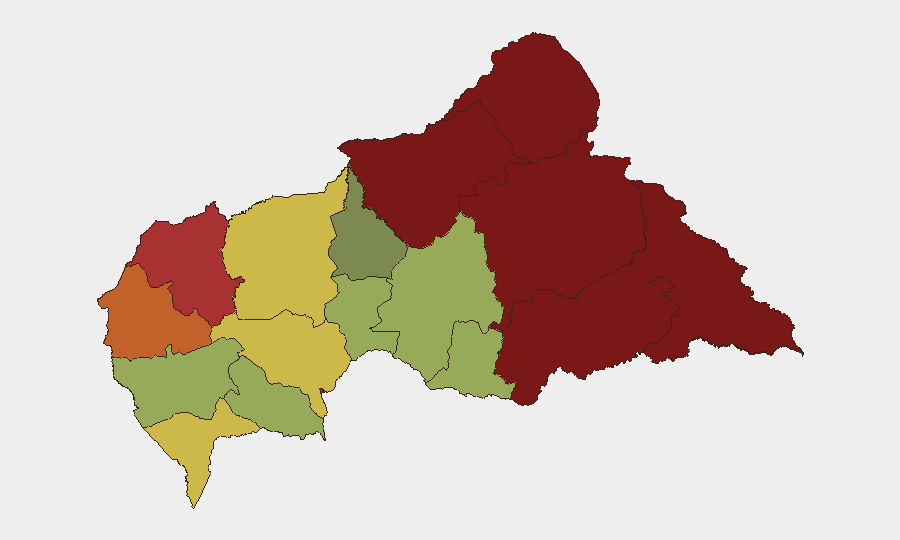
Situation Summary
Central African Republic remains at moderate-to-high composite threat (rank #34 globally, score 65), with insurgency and terrorism as primary drivers. The security picture this week is dominated by a significant mass-abduction incident in eastern Mbomou prefecture attributed to Lord's Resistance Army (LRA) elements, followed by accelerated government security deployments in the affected zone. No nationwide unrest or major urban incidents were reported; threat concentration remains in remote and peripheral prefectures, particularly the northeast and east.
Key Developments
- Bangassou area, Mbomou prefecture – 12–13 September 2026: Armed assailants attacked three villages near Bangassou, abducting between 30 and 44 people, including at least 13 children, in raids targeting fishers and hunters. Local officials and residents attributed the attacks to suspected LRA fighters, raising concerns of renewed LRA operational presence in eastern CAR. [Reported 16–17 September]
- Mbomou prefecture – 16–17 September 2026: CAR government forces deployed reinforcements and launched security operations across Mbomou, concentrating efforts on villages surrounding Bangassou in response to the abductions. Ongoing patrols and checkpoints were established to search for abductees and secure rural communities, with operations continuing through 19 September.
- Ouham prefecture, south-east of Buk – mid-September 2026: Joint security patrols located an illegal armed group encampment and engaged militants; one combatant was killed in the encounter. The incident indicates active armed-group presence and lethal security operations in the Buk area. [Reported 16–17 September]
- Mass abductions – children targeted: At least 13 minors remained unaccounted for as of 17 September following the Bangassou raids, intensifying humanitarian and protection concerns and signaling potential vulnerabilities in rural population security.
- LRA activity resurgence signal: Multiple corroborated sources linked the Bangassou incidents to LRA elements, suggesting renewed operational activity or repositioning in eastern Mbomou after a period of relative dormancy—a significant indicator for regional threat trajectory.
- International Criminal Court judgment – The Hague – 23 September 2026: The ICC scheduled public reading of judgment in a CAR war-crimes case (former militia leader Mahamat Said) for 23 September, announced 17–18 September. While the verdict falls outside the strict reporting window, the announcement reflects ongoing accountability dynamics and elite-behavior implications.
Highest-Risk Areas
Vakaga, Bamingui-Bangoran, and Haute-Kotto prefectures rank as the three highest-risk zones (95, 92, and 88 respectively), driven primarily by sustained insurgent and terrorist presence in remote borderlands. This week's confirmed incidents in Mbomou (rank 5, score 82) demonstrate that eastern and southeastern prefectures remain operationally active, particularly around Bangassou. Ouham prefecture (rank 10, score 65) shows parallel armed-group activity. The concentration of risk in peripheral, under-governed regions reflects LRA and other non-state armed groups' continued ability to conduct large-scale abductions with limited immediate government reach, despite security reinforcements.
How GeoBit Would Assist
Security teams with personnel or operations in CAR should employ GeoBit's AOI Monitoring & Early Warning capability to set persistent watches on Mbomou and Ouham prefectures, generating alerts on abduction incidents, security deployments, and armed-group movement. Network & Actor Analysis and multi-language OSINT (X/Twitter, Telegram, regional media feeds) enable real-time tracking of LRA communications, splinter-group claims, and government response posture. GIS & Spatial Analysis combined with Routing & Network Analysis supports alternative-route planning and safe-zone identification for staff transiting eastern CAR, particularly around Bangassou.
7-Day Outlook
LRA-linked activity in Mbomou is likely to sustain elevated vigilance and government patrols through late September, with continued risk of secondary abductions or reprisal raids in rural zones. The scale of the Bangassou incidents and retention of child captives suggest potential humanitarian negotiations or criminal ransom activity over the coming 10–14 days. No immediate escalation to urban centers or major security-force clashes is indicated, but remote-zone travel risk remains acute.
Highest-Risk Areas — Ranked
| # | State / Region | Risk |
|---|---|---|
| 1 | Vakaga | 95 |
| 2 | Bamingui-Bangoran | 92 |
| 3 | Haute-Kotto | 88 |
| 4 | Haut-Mbomou | 85 |
| 5 | Mbomou | 82 |
| 6 | Ouham-Pendé | 79 |
| 7 | Bangui | 78 |
| 8 | Nana-Mambéré | 75 |
| 9 | Sangha-Mbaéré | 68 |
| 10 | Ouham | 65 |
| 11 | Ombella-M'Poko | 62 |
| 12 | Kémo | 58 |
Sources
Previous Weekly Briefs
A new Central African Republic brief is written every Monday, covering the week — each with its own risk map and downloadable CSV. Use the calendar to go further back.
- September 15, 2026
- September 8, 2026
- September 2, 2026
- September 1, 2026
- August 31, 2026
- August 30, 2026
- August 29, 2026
📅 Browse past briefs by calendar →
Highlighted days have a brief. Tap a day for that day's map & analysis, or “csv” for that day's dataset ($5).
Atlas — our AI intelligence desk — emails them this snapshot personally. Nothing else, no list.