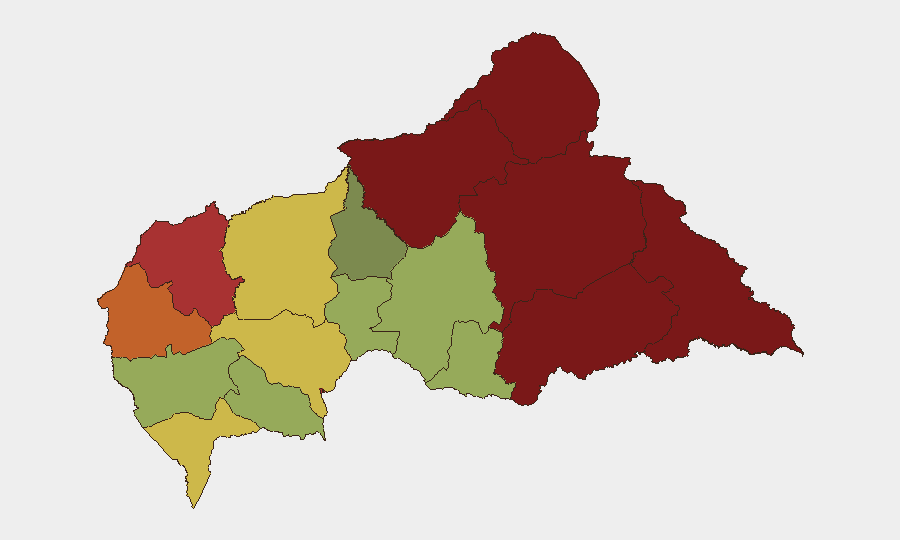
Situation Summary
Central African Republic remains in a precarious state of conflict-driven instability, with violence concentrated in the mineral-rich northeast and southeast and persistent armed-group activity across multiple prefectures. The past week saw limited discrete incident reporting, but underlying conditions—cross-border incursions, abductions, mining-site attacks, and civilian harm—remain consistent with the established threat pattern. Political volatility in Bangui, reinforced by international peacekeeping adjustments and reported disinformation campaigns, compounds the operational environment. The conflict trajectory shows no near-term de-escalation.
Key Developments
- Ouham-Bac prefecture, 29 September: An altercation resulted in two deaths, including one Central African Armed Forces (FACA) soldier. Incident details remain limited and require corroboration.
- Bangui, 1–2 October: Indonesia prepared to deploy 140 police personnel to the UN peacekeeping mission, signaling international concern over civilian protection and capital-region stability. The deployment underscores fragility in the seat of government.
- Northeast and southeast Central African Republic, 1 October: UN Security Council assessment confirmed ongoing cross-border armed-group incursions, attacks on mining operations, abductions, and criminal activity as persistent drivers of regional insecurity—conditions consistent with the sub-national risk ranking.
- Bangui, 4 October: Reports alleged use of AI-powered disinformation to portray opposition figures as armed militants, potentially inciting security-force action. The campaign reflects an emerging information-warfare dimension in an already unstable political environment.
- Central African Republic (general), 1 October: EU statement to the Human Rights Council documented continuing attacks on civilians, forced displacement, arbitrary detention, and restrictions on expression and assembly—patterns indicating systematic rather than isolated violations.
- Central African Republic (general), prior week (September 18–22): Recovery of eight abducted civilians by Central African defense forces with Russian support followed an armed attack near Rafaï that killed one civilian and abducted 11—illustrating ongoing abduction cycles and foreign military involvement in counteroperations.
Highest-Risk Areas
Vakaga, Bamingui-Bangoran, and Haute-Kotto prefectures drive the national threat score, each rated above 85. These northeastern and eastern zones—bordering Sudan, South Sudan, and Chad—experience the heaviest concentration of cross-border armed-group activity, mining-site attacks, and abductions. Haut-Mbomou and Mbomou in the southeast follow closely, driven by similar cross-border pressures and criminal networks. Bangui (risk 78), despite being the capital and focus of international peacekeeping, remains volatile due to political fragility and reported influence operations. Organizations with personnel or assets in the top five prefectures face material risk from armed conflict; those in Bangui face political instability and secondary security risks.
How GeoBit Would Assist
Security teams should employ AOI Monitoring & Early Warning with persistent watch on Vakaga, Bamingui-Bangoran, and mining corridors in the southeast to detect cross-border incursion patterns and abduction activity in near-real time. Intel Sweep and OSINT fusion across X/Telegram, radio SIGINT, and multi-language sources would track armed-group movements, Russian military activity, and disinformation campaigns affecting duty-of-care decisions in Bangui. GIS & Spatial Analysis and Satellite & Imagery analysis would support route planning for personnel and asset movement, identifying safer corridors and assessing mining-zone volatility.
7-Day Outlook
No significant de-escalation is expected in the coming week. Cross-border pressure will likely persist, and mining-zone attacks will remain probable. Political volatility in Bangui may deepen ahead of any governance shifts, and disinformation campaigns will continue to complicate the security environment. Organizations should maintain heightened vigilance in all prefectures ranked above 75 and ensure contingency protocols for Bangui remain current.
Highest-Risk Areas — Ranked
| # | State / Region | Risk |
|---|---|---|
| 1 | Vakaga | 95 |
| 2 | Bamingui-Bangoran | 92 |
| 3 | Haute-Kotto | 88 |
| 4 | Haut-Mbomou | 85 |
| 5 | Mbomou | 82 |
| 6 | Ouham-Pendé | 79 |
| 7 | Bangui | 78 |
| 8 | Nana-Mambéré | 75 |
| 9 | Sangha-Mbaéré | 68 |
| 10 | Ouham | 65 |
| 11 | Ombella-M'Poko | 62 |
| 12 | Kémo | 58 |
Sources
Previous Weekly Briefs
A new Central African Republic brief is written every Monday, covering the week — each with its own risk map and downloadable CSV. Use the calendar to go further back.
- September 28, 2026
- September 22, 2026
- September 15, 2026
- September 8, 2026
- September 2, 2026
- September 1, 2026
- August 31, 2026
📅 Browse past briefs by calendar →
Highlighted days have a brief. Tap a day for that day's map & analysis, or “csv” for that day's dataset ($5).
Atlas — our AI intelligence desk — emails them this snapshot personally. Nothing else, no list.