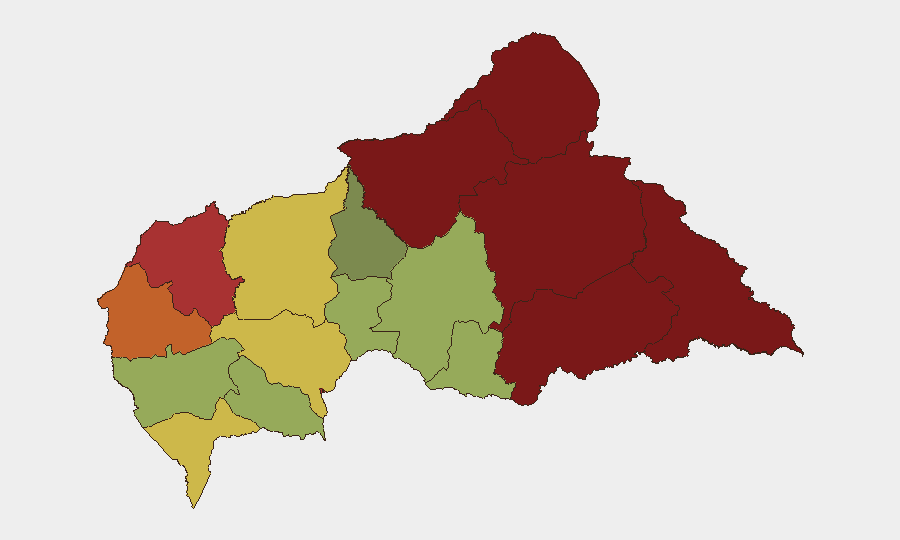
Situation Summary
Central African Republic remains a persistently fragmented security environment, ranked #34 globally with a composite threat score of 65, driven primarily by ongoing insurgency and terrorism activity. The country experienced no major tracked security incidents during the past week, though cross-border tensions with Chad have escalated into diplomatic protest, and a new Ebola case cluster in the Democratic Republic of the Congo near the CAR border presents emerging public-health risk. Insecurity remains concentrated in the country's northern and eastern prefectures; the capital and southern regions face lower but persistent criminal and protest-related risks.
Key Developments
- Bangui, 14 October 2026: The Central African Republic launched its first integrated criminal database, funded by the UN peacekeeping mission and UNODC, to standardize criminal records and improve law-enforcement information sharing across agencies—a structural step toward strengthened security governance.
- CAR–Chad border (Ab Nabak, Tissi region, Chad), 13 October 2026: Chad summoned CAR's ambassador to protest an alleged 10 October military incursion by Central African forces, with reports of injuries to military personnel and civilians; the diplomatic dispute remains active and unresolved.
- Nord-Ubangi, Democratic Republic of the Congo (CAR border), 16 October 2026: Congolese authorities confirmed two Ebola cases, including one fatality, designating Nord-Ubangi as the eighth affected province and creating a new cross-border public-health transmission risk for CAR—heightened concern given limited healthcare infrastructure in border zones.
- Bangui and national, 12 October 2026: Civil-society organizations coordinated a "dead city" transport shutdown from 04:00 to 17:00, protesting a ~12% diesel-price increase; the action was largely contained and completed as scheduled, indicating organized but non-violent civic pressure.
- Bégoua (north of Bangui, PK12), 6 October 2026: A 32-wheel Mercedes truck overturned, striking roadside businesses and pedestrians; six fatalities recorded—indicative of persistent road-safety and transport-infrastructure risks affecting civilian mobility in periurban zones.
Highest-Risk Areas
Vakaga, Bamingui-Bangoran, and Haute-Kotto prefectures (risk scores 95, 92, and 88 respectively) anchor the country's threat profile, driven by sustained insurgent presence, criminality, and limited state authority in the northeast. Haut-Mbomou and Mbomou in the southeast, and Ouham-Pendé in the northwest, remain secondary but significant risk zones (scores 85, 82, 79). Bangui itself registers 78, placing the capital above national average; insecurity drivers include organized crime, civil unrest, and protest activity concentrated in transport corridors and commercial districts. Southern prefectures (Sangha-Mbaéré, Nana-Mambéré, Ombella-M'Poko, Kémo) show lower composite scores but remain vulnerable to spillover effects and cross-border criminal movement.
How GeoBit Would Assist
Security teams should employ AOI Monitoring & Early Warning with persistent watch on Vakaga, Bamingui-Bangoran, and the CAR–Chad border zone to detect escalation in diplomatic or military activity. OSINT fusion and multi-language search capabilities enable real-time tracking of civil-society protest planning, armed-group communications, and public-health alerts (e.g., Ebola case surveillance). Routing & Network Analysis supports duty-of-care planning by identifying alternative transport corridors around high-risk prefectures and recent incidents (e.g., PK12 accident site), while GIS & Spatial Analysis correlates risk layers with corporate asset locations to inform evacuation and security-posture decisions.
7-Day Outlook
No major escalation is anticipated in the immediate term, though the CAR–Chad diplomatic dispute may harden if unaddressed through diplomatic channels. Ebola surveillance and cross-border health coordination should be monitored closely; any confirmed community transmission in CAR would materially increase regional risk. Diesel-price pressure and economic hardship may sustain periodic civic protests, particularly in Bangui; incidents are likely to remain localized and time-bounded unless governance response triggers broader labor action.
Highest-Risk Areas — Ranked
| # | State / Region | Risk |
|---|---|---|
| 1 | Vakaga | 95 |
| 2 | Bamingui-Bangoran | 92 |
| 3 | Haute-Kotto | 88 |
| 4 | Haut-Mbomou | 85 |
| 5 | Mbomou | 82 |
| 6 | Ouham-Pendé | 79 |
| 7 | Bangui | 78 |
| 8 | Nana-Mambéré | 75 |
| 9 | Sangha-Mbaéré | 68 |
| 10 | Ouham | 65 |
| 11 | Ombella-M'Poko | 62 |
| 12 | Kémo | 58 |
Sources
Previous Weekly Briefs
A new Central African Republic brief is written every Monday, covering the week — each with its own risk map and downloadable CSV. Use the calendar to go further back.
- October 12, 2026
- October 5, 2026
- September 28, 2026
- September 22, 2026
- September 15, 2026
- September 8, 2026
- September 2, 2026
📅 Browse past briefs by calendar →
Highlighted days have a brief. Tap a day for that day's map & analysis, or “csv” for that day's dataset ($5).
Atlas — our AI intelligence desk — emails them this snapshot personally. Nothing else, no list.